
Curacao Casino Licence for Australian Players Explained

- Online Curacao Casinos and Australian Regulations
- Land‑Based and Curacao‑Licensed Casinos in Australia
- Understanding Curacao Casino Licences for Australian Players
- How to Assess the Quality of Curacao Casinos
- Compliance Requirements for Curacao-Licensed Online Casinos Targeting Australians
- What the 2026 Curacao Licence Means for Australian Players
- Accessing Curacao Casino Sites from Australia: Blocking and Risks
- Crypto Casinos Licensed in Curacao – What Australian Regulators Say
Online Curacao Casinos and Australian Regulations
I have spent enough time on the operator side of this industry to know how the machinery works when a Curacao-licensed casino accepts an Australian sign-up. It works quietly. Nothing on the surface announces that the arrangement sits outside Australian law — the site loads, the games run, the withdrawals usually arrive. The legal reality is decided elsewhere: in the Interactive Gambling Act 2001, in the enforcement habits of the Australian Communications and Media Authority, and in the licence conditions written in a Caribbean jurisdiction that has never asked Canberra for permission.
This section is about that machinery — how online casinos holding a Curacao licence actually operate, and what Australian law says about them. It is deliberately not about the licence itself, or about how to judge a specific operator; those come later. Here the subject is the collision between two systems that do not recognise each other.
What "Curacao casino" actually means in practice
Strip away the branding and a Curacao online casino is a website that holds a licence issued by the gaming authority of Curacao, a constituent country of the Kingdom of the Netherlands. That licence is the operator’s legal permission to exist. It is not, and has never been, permission to offer real-money casino games to people in Australia. Under the Interactive Gambling Act 2001, offering unlicensed real-money online casino games to Australians is prohibited — and since no domestic licence for online casino games exists at all, there is no licence a Curacao operator could hold that would make its Australian-facing activity lawful here. The gap is not technical. It is total.
As Curacao licensing rules tighten ahead of 2026, Australian players benefit from checking exactly which authority backs an operator and what its welcome terms involve before signing up.
License: Curacao Gaming Control Board OGL/2023/174/0082 (Dama N.V.) · Bonus: up to A$5,000 + 300 free spins across 4 deposits Holds a Curacao Gaming Control Board license under Dama N.V., with a multi-deposit welcome package worth up to A$5,000 plus 300 free spins.
License: Curacao – Antillephone N.V. (Versus Odds B.V.) · Bonus: up to EUR 2,000 across 5 deposits + 200 free spins · Min. deposit: EUR 20 Licensed in Curacao via Antillephone N.V. under Versus Odds B.V., offering a sizeable welcome bonus spread across five deposits plus free spins, with a modest minimum deposit requirement.
License: Curacao eGaming (Dama N.V.) · Bonus: up to A$10,000 + 180 free spins, 40x wagering Operates under a Curacao eGaming license held by Dama N.V., pairing a large welcome bonus and free spins package with clearly stated 40x wagering terms.
Bonus: up to A$7,500 + 550 free spins across 10 deposits, 50x wagering · Payout speed: crypto under 1 hour, PayID 1-3 business days · Min. deposit: A$20 (A$30 to qualify for the bonus) Stands out for fast payout speeds, with crypto withdrawals processed in under an hour and PayID within a few business days, backing a substantial multi-deposit bonus package.
License: Curacao Gaming Authority (Jumpman Gaming Ltd) · Bonus: up to A$6,600 + up to 250 free spins across 4 deposits Licensed by the Curacao Gaming Authority under Jumpman Gaming Ltd, offering a solid welcome package with free spins spread over multiple deposits.
License: Curacao eGaming (Roby Games Ltd) · Bonus: 100% up to A$750 + 200 free spins Runs under a Curacao eGaming license held by Roby Games Ltd, with a straightforward welcome bonus matched by a free spins allowance.
Bonus: 240% up to A$4,100 + 300 free spins Notable for a high-percentage welcome bonus combined with a generous batch of free spins.
License: international iGaming licence – jurisdiction not named in the source · Bonus: 100% up to A$1,000 + 100 free spins, 35x wagering · Payout speed: PayID 1-24 hours · Min. deposit: A$30 (PayID from A$10) Operates under an international iGaming licence, with quick PayID payouts and a welcome bonus that includes free spins and clearly defined wagering requirements and deposit minimums.
License: Curacao eGaming (Hollycorn N.V., since 2017) · Bonus: 225% up to A$1,540 + 600 free spins across 4 deposits, 20x wagering · Min. deposit: A$20-30 (depends on the offer) Licensed under Curacao eGaming via the long-established Hollycorn N.V. (since 2017), offering a high-percentage bonus with free spins across several deposits and comparatively low wagering requirements.
License: Curacao Gaming Control Board · Bonus: up to A$5,000 + 400 free spins Licensed by the Curacao Gaming Control Board, with a welcome offer combining a sizeable bonus amount and a solid allotment of free spins.
From the operator’s chair, this creates an awkward daily routine. The casino is fully licensed where it is licensed. Its games, its servers, its payment processing — all of it is legal in the jurisdiction that issued the licence. The prohibition applies at the Australian end, to the act of providing the service to people in Australia. The law targets operators, not players, which means individual Australians who visit offshore-licensed online casinos are not committing an offence themselves. I have watched compliance officers wrestle with exactly this asymmetry: the operator is exposed, the customer is not, and every commercial incentive pushes the operator toward the Australian market anyway.
The mechanics of serving that market are unremarkable. The site is hosted offshore. Payments run through whatever channels the operator has arranged — cards, bank alternatives, and, increasingly, crypto rails. The games themselves are supplied by the same studios that supply everyone, and the operator’s margin of comfort comes from distance: distance between the licence, the servers, the payment entity, and the player’s screen in Perth or Parramatta. When it works, the player never notices any of it. When it stops working — a blocked domain, a frozen payment channel — the whole structure becomes visible at once.

The Interactive Gambling Act 2001, plainly
The Interactive Gambling Act 2001 is the primary Commonwealth law governing online gambling in Australia, and its logic is easier to follow than most legislation. The Commonwealth cannot licence online gambling; it can only prohibit it. So it prohibits offering certain online gambling services to people in Australia. Casino-style games — slots, blackjack, roulette, the live-dealer tables that Curacao sites specialise in — all fall inside the prohibition. Online poker joined them when the 2017 amendment to the Act closed the online poker gap; before that amendment, poker lived in a grey area that offshore operators had worked hard to keep grey.
What the Act deliberately leaves alone is wagering. Pre-match online betting is legal in Australia, but only through operators licensed by a state or territory. Online in-play sports betting is prohibited — the law draws the line at bets placed after an event has started when those bets travel over the internet, while the same bet accepted over the phone remains lawful. I have always found that carve-out the most honest illustration of how this statute was drafted: it is not a principled line between acceptable and unacceptable gambling. It is a line drawn around what could be agreed in 2001 and defended since.
So the Australian online gambling landscape is split by design. On one side: state-licensed wagering, with its obligations — pre-verification of identity before customers can deposit or bet, a prohibition on credit cards and credit-linked products, integration with the national self-exclusion register. On the other side: everything else, which is prohibited, and which Curacao-licensed casinos constitute in their entirety. A Curacao casino offering slots to an Australian is not operating in a regulatory gap. It is operating inside an explicit prohibition.
Offering unlicensed real‑money online casino games to Australians is prohibited under the Interactive Gambling Act 2001.
ACMA and the enforcement reality
The body that polices the Interactive Gambling Act 2001 is the Australian Communications and Media Authority. Understanding what ACMA actually does — and does not do — explains most of what a Curacao casino’s business model in Australia depends on.
ACMA does not chase individual gamblers. Its instruments are aimed at the infrastructure that carries the service: the websites, and to a lesser extent the advertising and payment arrangements around them. ACMA maintains a list of blocked websites, with enforcement applied through ISP blocking — Australian internet providers are directed to stop resolving the domains of prohibited gambling services. According to onlinegamblingregulations.com, ACMA maintains a public list of these blocked sites, which is worth checking directly rather than relying on secondhand reports, since the list changes as new sites are added and operators migrate.
And migration is the whole game. I have watched a domain go from fully functional to a blank page overnight, and the same casino reappear under a different domain within days. Blocking a domain does not block a business. The licence, the games portfolio, the player database, the wallet balances — all of that lives offshore and moves freely. What ISP blocking does is raise friction: it makes access intermittent, it breaks saved bookmarks and payment flows, and it pushes the less determined portion of the customer base toward legal alternatives. For a regulator with limited extraterritorial reach, friction is the available product. It is not nothing. It is also not enforcement in the sense a domestic licensee would understand the word.

From the operator side, the calculation is straightforward. Australia is a wealthy, English-speaking market with high card penetration and no licensed domestic online casino to compete with. Against that stands an enforcement regime that can take domains away but cannot reach the licence, the servers, or the directors. Some Curacao operators weigh that and decline the market; others treat blocked domains as a cost of doing business. Nothing in the Curacao licence forces the second choice, and nothing in it prevents the first.
Why the Curacao model and the Australian model do not mix
It helps to line the two regulatory philosophies up next to each other, because the mismatch is structural rather than accidental.
Australian online gambling regulation — the legal part of it, wagering — runs on player protection as a condition of market access. Pre-verification of identity must be completed before a customer can place a bet or deposit funds. Credit cards are prohibited for online wagering. Operators must integrate with BetStop, the national self-exclusion register, and immediately block individuals on it. Wagering providers carry anti-money-laundering and counter-terrorism-financing obligations. Responsible gambling tools — deposit limits, loss limits, time limits, timeouts, self-exclusion options — are part of the licence, not a customer-service courtesy. The state or territory that issued the licence can inspect, sanction, and ultimately revoke it.
The Curacao model runs on a different premise. The licence certifies that the operator exists, is registered somewhere reachable, and has accepted a set of obligations written in Curacao. Those obligations are real, but they are Curacao’s obligations, calibrated to Curacao’s enforcement appetite and jurisdiction. Nothing in them incorporates Australian standards, because there is no mechanism by which they could. When a Curacao casino advertises "licensed and regulated" to an Australian audience, the phrase is true and misleading at once — true about the licence, misleading about its relationship to Australian law. I have written marketing copy in this industry, and that two-word shield does more work than any disclaimer.
Legal risk
Curacao‑licensed casinos operate outside Australian regulatory frameworks, so operators face no Australian oversight and players have no legal protection.
The practical consequences are not abstract. An Australian wagering customer who is on BetStop is blocked across every licensed wagering operator in the country, because the register is national and integration is mandatory. A Curacao casino has no such integration, no access to the register, and in most cases no idea it exists. A customer whose identity is pre-verified at an Australian wagering site cannot deposit until that verification clears; at a Curacao site, verification is whatever the operator’s own risk appetite says it should be, which historically has meant later rather than sooner. These are not edge cases. They are the ordinary daily difference between the two systems.
The federal–state split, and where Curacao casinos fall through it
Australian gambling law is split across federal and state/territory frameworks, and the split matters for understanding why offshore casino regulation looks the way it does.
Land-based gambling is licensed at the state and territory level. Each state and territory has its own licensing regime, its own regulator, and its own harm-minimisation rules. A casino in Sydney answers to different authorities than a casino in Melbourne or Darwin, under statutes that were written separately and enforce differently. Online wagering is licensed by states and territories too — the Northern Territory, in particular, has been the licensing home for a large share of Australian-facing online bookmakers — but it is also subject to federal restrictions under the Interactive Gambling Act 2001.
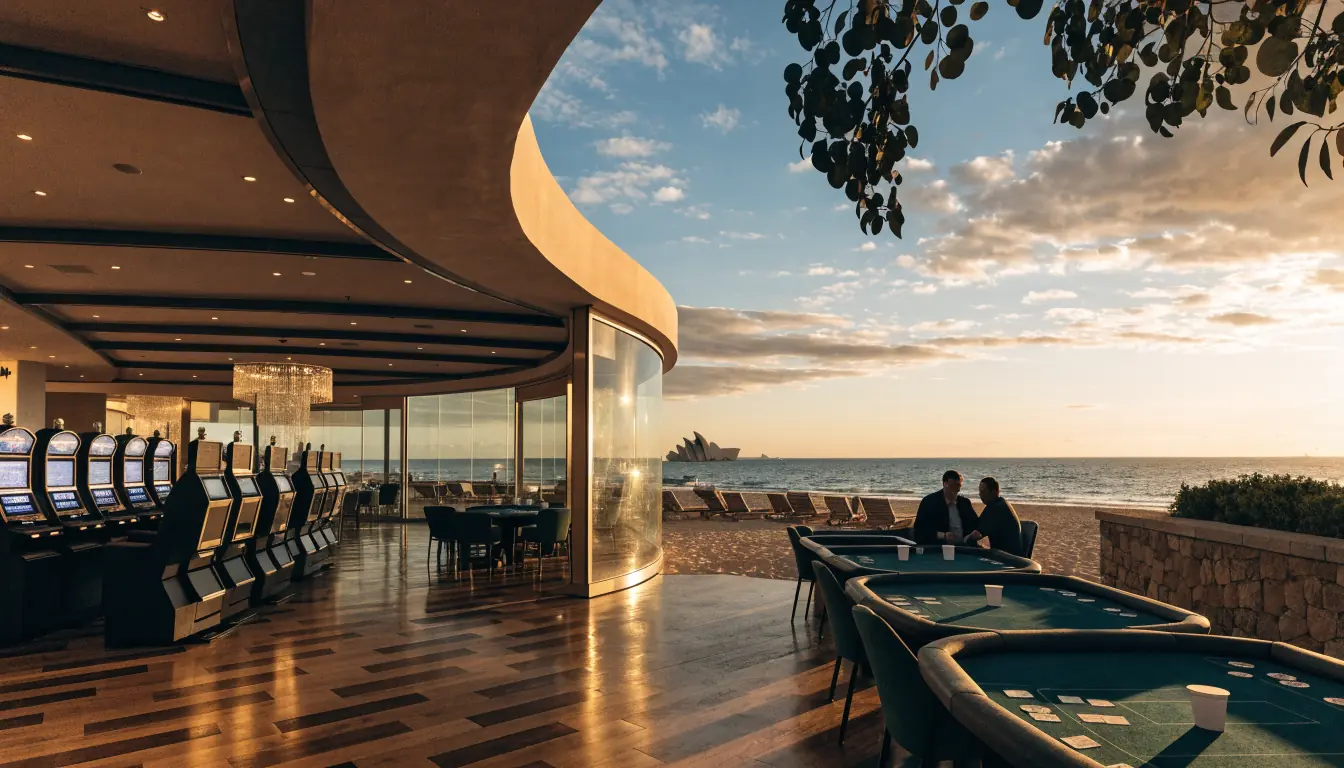
Online casino games have no place in either column. The Commonwealth prohibits them outright; the states do not license them, because doing so would collide with the federal prohibition. So there is no state licence a Curacao operator could obtain, no state regulator it could submit to, and no state harm-minimisation framework it would inherit if it wanted one. The space that domestic operators fill through a licence, a Curacao operator fills through absence — absence of Australian authority, absence of Australian obligations, absence of Australian recourse for the player.
That last part is the one marketing copy never mentions. A player with a dispute against a state-licensed Australian operator has a regulator, a complaints pathway, and a licence that the operator cannot afford to lose. A player with a dispute against a Curacao casino has the casino’s own complaints process and, if that fails, whatever the licence certificate’s dispute mechanism delivers. Australian Consumer Law does apply to gambling businesses in the sense that misleading advertising and unclear terms are actionable — but enforcing consumer rights against an offshore entity with no Australian assets is a different exercise from enforcing them against a licensee down the road.
What remains legal, and the border Curacao casinos cannot cross
It is worth being precise about what an Australian can legally do online, because the Curacao marketing playbook depends on blurring it.
Pre-match online betting through a state or territory-licensed operator: legal, with the full protective apparatus attached. Lotteries, which remain state monopolies with online sales permitted: legal. Online casino games, online poker, online in-play betting: prohibited as services offered to Australians, with no licensing pathway. That third category is precisely and completely the product of a Curacao online casino. There is no version of a Curacao-licensed site serving Australians that sits on the legal side of the line, because everything it sells sits on the wrong side.
Australian players can legally place pre‑match bets with state‑licensed operators, but offshore Curacao casino games remain prohibited.
The player-side position is different, and it is the second fact the marketing playbook leans on. It is not illegal for individual Australians to play at offshore-licensed online casinos; the Interactive Gambling Act 2001 targets operators, not players. An Australian who signs up, deposits, and plays at a Curacao casino breaks no Australian law by playing. What that player does not have is any of the protections that attach to legal gambling: no mandatory pre-verification before deposit, no credit card prohibition enforced by anyone with jurisdiction, no guaranteed self-exclusion mechanism tied to a national register, and no regulator whose job it is to take the call when something goes wrong.
The "best" framing deserves a word, because the search behaviour around Curacao casinos is saturated with it — best online casino Curacao, best site, best bonus. Having seen the inside of this industry, I can say what that word is worth: almost nothing. Curacao licence conditions do not translate into a ranking. What separates one Curacao operator from another is internal policy — how it handles verification, withdrawals, and complaints — none of which is standardised by the licence and none of which is independently enforced on the player’s behalf. A casino can be "the best" in the sense of being the most competent at a business that carries no Australian obligations. It cannot be the best in the sense an Australian licensed operator can, because the standard that would measure it does not apply.
Where this leaves the arrangement
An online casino licensed in Curacao serving Australians is a legal business in Curacao offering a prohibited service into Australia, betting — commercially, not legally — that enforcement will not reach it. Australian regulation answers with what it has: the Interactive Gambling Act 2001’s prohibition, ACMA’s policing of it, and ISP blocking of the domains that carry the traffic. The customer sits in the middle, unprosecuted and unprotected at once, with the choice framed by a licence that Australia does not recognise and a law that the licence does not recognise.

That is the structural picture. The sections that follow take it apart piece by piece — what the Curacao licence itself covers, how land-based licensing in Australia compares, and what an operator genuinely serving this market would have to do to meet obligations it has never been asked to meet. The mechanics deserve the detail. The shorthand does not survive it.
Land‑Based and Curacao‑Licensed Casinos in Australia
Two kinds of casino can appear in the same search result, and they have almost nothing in common beyond the word "casino" in the name. One is a building in Sydney, Melbourne or Perth with a state regulator watching every table. The other is a website holding a licence from Curacao, a jurisdiction that has never inspected a single Australian premises and never will. I’ve dealt with both sides of this divide, and the differences start long before a player places a bet — they start with who approves the roulette wheel, the dealer, and the hours the doors stay open.
How Australia Licenses a Physical Casino
Land-based gambling in Australia is licensed at the state and territory level. There is no national casino regulator in the way many people imagine; the Commonwealth sets the framework for interactive gambling, but a brick-and-mortar casino exists because a state government decided it should, and because a state regulator continues to decide, almost daily, that it should keep existing.
Each state and territory has its own licensing regime, its own regulator and its own harm-minimisation rules. What that means in practice is that a casino in one state operates under conditions that can differ materially from a casino in the neighbouring state — different approval processes, different oversight cultures, different enforcement histories. A licence is not a national passport. It is a permission tied to one building, one operator and one set of local rules.
New South Wales is the clearest example of how deep this oversight goes, partly because its system was rebuilt in recent years. The NSW Independent Casino Commission — the NICC — was established by amendment of the Casino Control Act 1992 on 5 September 2022. That date matters more than it looks. Before 2022, the Independent Liquor & Gaming Authority, ILGA, conducted the reviews, investigations and inquiries relating to casino licences and operations. The handover was not a rebranding; it followed inquiries that exposed how much a regulator can miss when its attention is split across liquor, gaming and casino matters. The NICC was created to do one job: watch casinos.
What a State Regulator Actually Controls
This is the part that rarely appears in marketing copy, and it is the clearest contrast with the Curacao model. In a state-licensed Australian casino, the operator does not decide what games run, on what equipment, staffed by whom, at what hours. The regulator does — or at least signs off on every one of those decisions.
Liquor & Gaming NSW assists the NICC in overseeing casino operations, including overt and covert operations. Read that phrase carefully: overt and covert operations. Inspectors walk the floor openly, and they also come in ways the floor staff cannot anticipate. A casino operating under this regime knows it may be observed at any moment without knowing it. That possibility shapes behaviour in a way an annual compliance report never will.
The granularity of control is what surprised me when I first saw it from the inside. L&GNSW approves and licences relevant casino staff — not just senior management, but the people with their hands on the games. L&GNSW approves the games to be played in a casino and the rules under which such games are played, so a casino cannot quietly change a blackjack payout structure or introduce a variant the regulator hasn’t examined. L&GNSW approves gaming equipment for use in a casino — the physical machines, the tables, the certified RNG systems where electronic games are involved. And L&GNSW approves the operating times of a casino, which means even the clock on the wall is a regulated matter.
Put together, this amounts to a simple principle: nothing enters an Australian casino floor without a regulator’s prior approval, and nothing on that floor escapes continuing scrutiny. The licence is not a one-off certificate. It is an ongoing relationship in which the regulator sits, permanently, inside the operator’s decision-making.

The Contrast: What a Curacao Licence Oversees
A Curacao licence operates on the opposite assumption. It is issued to a company — often a company registered somewhere other than Curacao itself — and it covers online activity, not premises. There is no floor to walk, no equipment to physically inspect, no staff whose faces an inspector would recognise on a return visit.
I want to be careful here about what a Curacao licence does and does not claim to cover, because the marketing around it is deliberately vague. The licence is a legal basis for an operator to run gambling services internationally; it is not, and has never been, a guarantee of oversight comparable to a state regime. When a Curacao-licensed site uses words like "licensed" and "regulated" in its footer, what stands behind those words is a framework that certifies the operator’s paperwork rather than the operator’s daily conduct.
The distinction that matters for an Australian comparison is this: an Australian state regulator approves games before they are played and watches them while they are played. A Curacao licence, whatever its internal processes, cannot extend that kind of supervision to a website serving Australians, because its authority does not reach into Australia at all. No Curacao inspector is running covert operations on an online casino’s live dealer studio. The concept doesn’t apply.
And there is a more fundamental point, which the licensing comparison sometimes obscures: offering online casino games to people in Australia is prohibited under the Interactive Gambling Act 2001 regardless of where the operator is licensed. A Curacao licence does not unlock the Australian market. It never has. From the Australian legal perspective, the question "is this Curacao casino properly licensed?" is close to a category error — no offshore licence of that kind is recognised here for casino games, because no such licence can be granted for the Australian market at all. There are no domestically licensed real-money online casino operators available to Australian players, and it is not possible to obtain a licence to operate an online casino domestically. The Curacao licence exists in a space Australian law has simply closed off.
Two Frameworks, Two Ideas of What a Licence Means
The comparison between the two frameworks comes down to what each system thinks a licence is for.

The Australian state model treats a licence as a conditional, revocable privilege attached to continuous good behaviour. The operator earns the right to open the doors each morning by staying within conditions that the regulator can tighten, inspect and enforce on the spot. The events in NSW that led to the NICC’s creation showed what happens when that supervision fails — and the institutional response was to make supervision stronger and more focused, not to soften it. That trajectory tells you the direction of travel for land-based regulation in this country.
The Curacao model, as it presents to Australian players, treats a licence more as a commercial credential. It allows an operator to say "licensed casino" on a landing page, process payments under a recognised gambling licence, and operate across many jurisdictions whose laws it has no obligation to satisfy beyond its own. For an Australian player, that credential says nothing about Australian consumer protections, because none were designed for this market and none apply.
This is why the familiar advice — "check the licence before you play" — breaks down when it crosses into the offshore space. Checking a Curacao licence confirms only that the operator holds a Curacao licence. It does not confirm that anyone supervises the games the way L&GNSW supervises a Sydney casino floor, because no one does. There is no public registry of licensees serving this market that an Australian player could consult, and no Australian regulator standing behind the certificate. The licence is real; the protection a player might assume it carries is not.
Consumer Law and Responsible Gambling: Who Enforces What
The difference in frameworks shows up most sharply in the protections attached to play.
An Australian land-based casino operates inside a dense web of obligations. Australian Consumer Law applies to gambling businesses and requires accurate advertising and clear terms — a regime with genuine enforcement behind it. Operators must have a published privacy policy if they collect customer data. Responsible gambling tools include deposit limits, loss limits, time limits, timeouts and self-exclusion options, and the state regulator expects these to be real, working mechanisms, not decorative links at the bottom of a page. Self-exclusion programmes in the land-based context are tied to identifiable premises and staffed enforcement.

None of this architecture travels with a Curacao licence. A Curacao-licensed site may offer deposit limits and timeouts, and some do, but whether they exist, how they work, and whether anyone verifies them is a matter of that operator’s own policy. There is no L&GNSW equivalent approving the tools. There is no state regulator that has approved the games, the equipment or the staff. There is no regime of overt and covert operations. The player’s protection, in the end, is whatever the operator chose to build — and the operator answers to Curacao, not to any Australian body.
For context on where Australian law does allow licensed online gambling: online wagering is licensed by states and territories, subject to federal restrictions on interactive gambling, and those licensed wagering operators must integrate with BetStop, the national self-exclusion register, and conduct pre-verification of identity before a customer can bet or deposit. That is what a recognised Australian licence looks like online — obligations designed for, and enforceable against, operators serving this market. The contrast with an offshore casino licence is not subtle.
Why the Comparison Keeps Coming Up
The reason players keep comparing "casinos in Curacao" with Australian casinos is that they occupy the same mental slot while living in different legal worlds. Both offer slots, table games, the vocabulary of casino play. But one operates inside a system where a state regulator approves the games, licences the staff, certifies the equipment and controls the operating hours — and can send inspectors in, overtly or covertly, whenever it chooses. The other operates from a jurisdiction whose oversight, however real on paper, has no purchase on the Australian side of the transaction.
When someone searches for the "best Curacao casinos" or the "top casinos" licensed there, what they are usually looking for is reassurance — a list that separates the trustworthy from the rest. I can’t provide that list, and I’d distrust anyone who claims to, because the criteria that make such a list meaningful in a licensed market don’t transfer. In Australia, "trustworthy" is not a reputation score; it is the output of a regulatory machine that approves, inspects and enforces. For a Curacao-licensed site serving Australians, that machine does not run. The operator is on the honour system, and the honour system is not a licensing framework.

The honest comparison, then, is not between two kinds of casino. It is between a casino whose every working detail is subject to approval, and a casino whose every working detail is subject to its own discretion. Players weighing the two should understand that before they weigh anything else.
Understanding Curacao Casino Licences for Australian Players
A Curacao licence is often presented in banner form at the bottom of an offshore casino site, and from the inside of the industry I can say what that badge actually is: a single permission issued by the authorities of a small Caribbean jurisdiction covering a wide range of gambling products under one umbrella. That breadth is the commercial appeal. An operator can run slots, table games and lotteries on one licence rather than applying product by product.
What the licence does not do is carry any weight in Australia. A Curacao licence casino is, from the standpoint of Australian law, an unlicensed operation, because there is no category of domestic licence it could map onto. Real-money interactive gambling of the casino type is prohibited under the Interactive Gambling Act 2001, and no offshore permission changes that. The licence covers the operator’s obligations to Curacao — not to Australian players.
Contrast that with how domestic licensing works. Each Australian state and territory has its own licensing regime, its own regulator and its own harm-minimisation rules. Online wagering, the one broadly available interactive product, is licensed at that state and territory level — the Northern Territory Gambling Commission is the best-known example — while still sitting under federal restrictions on interactive gambling. A licensed Australian wagering operator answers to a regulator that can audit it, fine it and, in serious cases, strip the licence.
Land-based casino licensing is stricter still. In New South Wales, the NSW Independent Casino Commission was established by amendment of the Casino Control Act 1992 on 5 September 2022, replacing an earlier arrangement and bringing with it overt and covert operations to police licence conditions. That is what a genuine licensing regime looks like: a regulator with teeth, located in the same jurisdiction as the players it protects.

A Curacao licence sits outside all of this. It confers no rights in Australia, imposes no BetStop checks on the operator’s own initiative, and offers no Australian avenue for complaint. The two documents share a word — "licence" — and almost nothing else.
How to Assess the Quality of Curacao Casinos
There is no "best" Curacao casino in any sense an Australian regulator would recognise, because no Curacao licensee can legally offer real-money casino games to Australians under the Interactive Gambling Act 2001. That caveat stated, the quality question still matters: people encounter these sites, and some are run more competently than others. The assessment comes down to observable features, not marketing copy.
The first thing to check is responsible gambling tooling. A licence document proves nothing on its own; the tools do. Deposit limits, loss limits, time limits, timeouts and self-exclusion options should exist as functioning account settings, not as a paragraph in the terms. Sites that bury these features or make them reversible through a support chat are telling you how they actually view player protection.
The second marker is financial diligence. Wagering operators that take their obligations seriously carry anti-money-laundering and counter-terrorism-financing procedures, which in practice means KYC checks that happen before large withdrawals, not after a dispute. A "fast, no-verification" pitch sounds convenient and is the opposite of a control.
Third, look at who polices the operator. A Curacao licence is not an Australian one, and there is no domestic register of online casino licensees to check against — no official list exists, and any site claiming to appear on one is embellishing. Complaints handling, published contact details and a real privacy policy are the available substitutes.
Marketing is the last filter. "Generous" bonuses with undisclosed wagering requirements, promotions aimed at excessive play, or anything resembling appeals to minors — these are the disqualifiers. Reputable operators state terms plainly.
None of this makes an offshore casino legal for Australians. It only separates the sloppy from the structured.
Compliance Requirements for Curacao-Licensed Online Casinos Targeting Australians
A Curacao licence covers the operator’s obligations in Curacao. It covers nothing in Australia. The moment a casino accepts an Australian customer, Australian requirements start attaching to that relationship, and almost none of them are things a Curacao licence was built to deliver.
The clearest example is BetStop. Any online wagering provider operating lawfully in Australia must integrate with the national self-exclusion register and block registered individuals immediately. A casino sitting offshore has no integration, no feed, and no legal mechanism to receive one — the register was designed for domestically licensed operators. The "self-exclusion programme" listed on a Curacao casino’s responsible gambling page is its own internal tool, which is a different instrument entirely: voluntary, self-administered, and unenforceable from outside.
Anti-money-laundering duties tell a similar story. Wagering service providers under Australian oversight carry AML and counter-terrorism-financing obligations, supervised by AUSTRAC. A Curacao-licensed casino has its own AML framework, but it answers to Curacao’s regime, not to the Australian one — which means there is no regulator standing behind the Australian customer’s complaint if that framework fails.
Two practical consequences follow. First, the protections that exist for Australian gamblers — pre-verification, credit card bans, deposit limits enforced by a regulator — exist because someone with enforcement power requires them. Remove the regulator, and the requirements become policies: written, advertised, and revocable at will. Second, any casino marketing itself to Australians as "fully compliant" is making a claim that cannot be true in the domestic sense, because there is no domestic licence it could hold.
Compliance follows the licence, not the customer.
What the 2026 Curacao Licence Means for Australian Players
A reformed Curacao licence, however it is structured in 2026, is a Curacao document. It has no standing here. The Interactive Gambling Act 2001 prohibits offering certain online gambling services to people in Australia, and no offshore licence carves a path through that prohibition. From the Australian side, a Curacao-licensed casino operating in 2026 sits in exactly the same legal position it occupied before: unlicensed real-money casino games cannot lawfully be offered to Australians, full stop.
What the reforms may change is the operator’s paperwork — who stands behind the licence, what supervision Curacao actually performs. That matters if something goes wrong and you need to complain. It does not change what is offered, or whether it should be offered here.
I’ve watched offshore licences get "stronger" before. The carve-out never arrives. Australian law doesn’t move for it.
Accessing Curacao Casino Sites from Australia: Blocking and Risks
The Australian Communications and Media Authority polices the Interactive Gambling Act 2001, and Curacao-licensed casino domains are its natural prey. Enforcement runs at the network level: according to onlinegamblingregulations.com, ACMA maintains a public list of blocked websites with ISP blocking — a domain lands on the list, and internet service providers cut it off for Australian connections.
What the list does not do is touch the player. The IGA targets operators, not individuals, which is why the blocking regime, not prosecution, is the main practical consequence an Australian user encounters.
Bypassing the block — a VPN, a mirror domain — restores access but not protection. A casino that Australia has blocked is under no obligation to honour deposits, disputes or self-exclusion programmes. When a Curacao site vanishes with the money, there is no domestic regulator to call. The block is the warning.
Crypto Casinos Licensed in Curacao – What Australian Regulators Say
Crypto-based casinos holding a Curacao licence market themselves on privacy: deposits in Bitcoin or stablecoins, quick payouts, and minimal questions. From the Australian side of the counter, that pitch reads differently.
The Interactive Gambling Act 2001 applies to these platforms the same way it applies to any offshore casino — real-money interactive gambling cannot be lawfully offered to people in Australia, regardless of what currency the chips are denominated in. A Curacao licence does not change that; it simply has no standing here.
The crypto element adds a second layer. Domestically licensed wagering providers carry anti-money-laundering and counter-terrorism-financing obligations, and AUSTRAC polices that space. Crypto casinos with no KYC to speak of sit outside any framework an Australian regulator can reach.
Privacy policies are the one concrete check available: an operator collecting customer data must have one published. When a crypto casino offers neither that nor any traceable licence detail, "privacy" often just means no recourse.
Two words: unregulated rails.
How can a player verify that an online casino holds a valid licence in Australia?
No online casino licence exists in Australia at all — the Interactive Gambling Act 2001 prohibits offering real-money online casino games to Australians, so no operator can be validly licensed for them. You can check ACMA’s public list of blocked websites, which shows which offshore sites have been found prohibited. State or territory licences only cover wagering and land-based gambling.
Are crypto casinos legal in Australia in 2026?
No. Crypto casinos are still online casinos under the Interactive Gambling Act 2001, and offering real-money casino games to Australians is prohibited regardless of whether payments run on crypto rails. The law targets operators, not players, but that does not make the service lawful.
Is online casino legal in Australia?
No. Since the Interactive Gambling Act 2001 there is no domestic licence for online casino games, so offering them to Australians is prohibited — only pre-match online betting through state or territory-licensed operators is legal. Australian players who visit offshore casinos do not commit an offence themselves, but the operator does.
Where can I complain about an online casino in Australia?
The relevant authority is the Australian Communications and Media Authority (ACMA), which polices the Interactive Gambling Act 2001 and maintains enforcement through website blocking. Complaints about consumer matters, such as misleading advertising or unclear terms, may also fall under Australian Consumer Law.