
Best Live Casino Online Australia: 2026 Guide
 Available in AU
- Live Casino Regulations Specific to Australia
- Live Casino Experience in Australia 2026
- Live Casino Software Providers and Free Options
- Live Casino Poker: Providers and Gameplay
- Live Casino Games Landscape: Slots, Table Games and RTP
- Live Roulette Sites for Australian Players
- Live Dealers and How They Operate
- Live Casino Availability in the USA
- Playing Live Casino Anywhere: Mobile and International Access
- Top Live Casino Apps and Platforms
Live Casino Regulations Specific to Australia
The Interactive Gambling Act 2001 is the piece of legislation everything else in this space hangs on. It prohibits Australian companies from offering online casino services — live dealer tables included — to residents. There is no domestic licence an operator can apply for to run live blackjack or roulette for the Australian market. None exists. Any platform streaming a live table to a player in Sydney or Perth is doing so from offshore.
What that means in practice: the law targets operators, not players. It is not illegal for an individual Australian to sit at an offshore-licensed live table. That distinction shapes the whole market — every casino reviewed on this site sits outside the Australian licensing system by definition, because the system has nothing to offer it.
Two rules are fixed regardless of where the operator is based. The minimum age is 18, full stop — offshore does not mean laxer on this point at any operator worth depositing at. And deposits are handled in Australian dollars; the platforms competing for this market in 2026 accept AUD, sparing players conversion fees that quietly eat into a bankroll before a single hand is dealt.
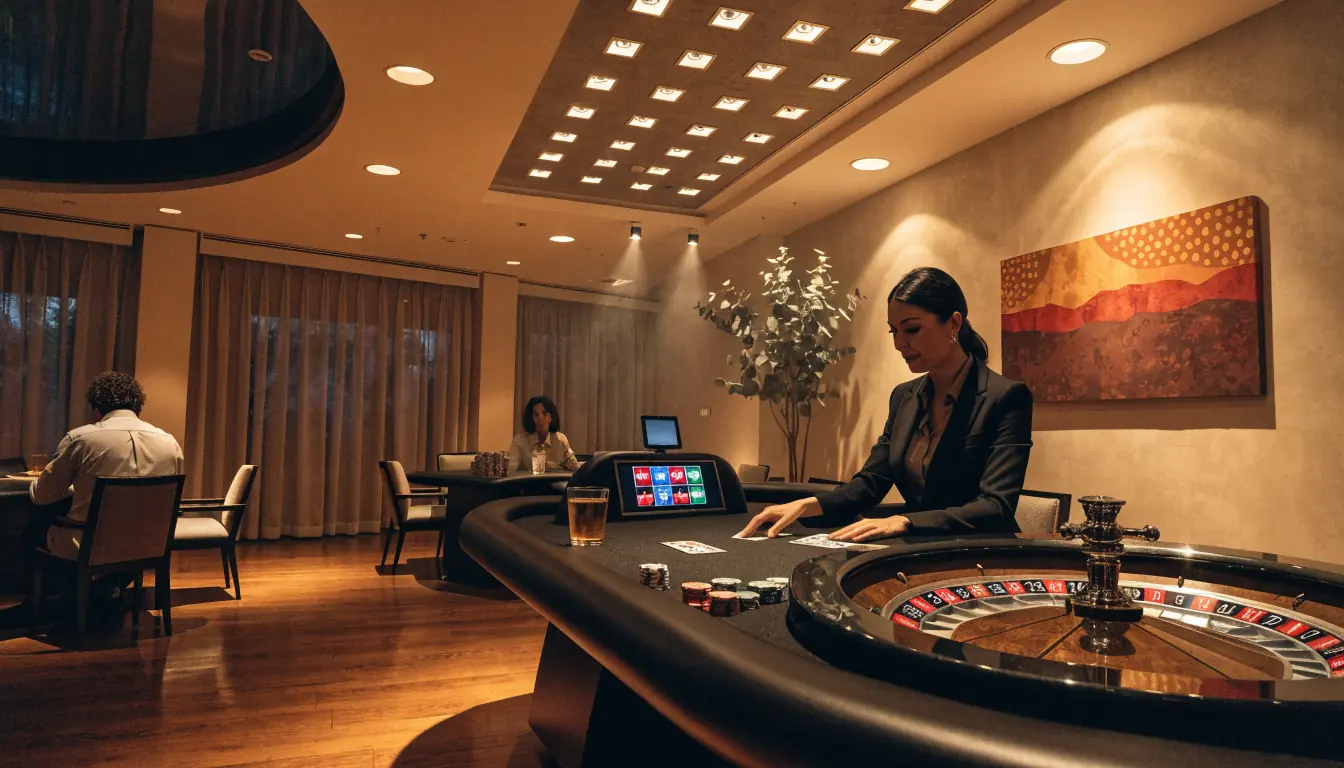
Comparisons get made with the UK, where live casinos are licensed domestically and regulated openly. Australia runs the opposite model: prohibition on the supply side, tolerance on the demand side. Useful to keep in mind whenever a site advertising to Australians claims an "Australian licence" — there is no such thing to claim.
That last claim is the tell.
Live Casino Experience in Australia 2026
I’ve spent enough time watching the money move to know this: the live casino market in Australia isn’t really defined by the tables anymore. The roulette wheel looks the same whether you’re playing in Melbourne’s timezone or anywhere else. What separates a good year from a frustrating one is what happens before you sit down and after you stand up — deposits, withdrawals, and whether the whole thing works on the device you actually hold in your hand.
That’s the part worth examining closely in 2026, and it’s the part most reviews skim past because it isn’t glamorous.
The banking layer is the product now
A live casino is a real-time product. You’re watching a stream, you’re making decisions in seconds, and the money in your account needs to keep pace with that rhythm. A deposit that takes a day to clear doesn’t just delay play — it breaks the entire proposition.

In 2026, Australian-facing platforms have largely converged on the local instant payment system, PayID, as the default rails for AUD deposits and withdrawals. This matters more than it sounds. Australia’s major banks may block transactions to gambling sites — that’s not a rumour, it’s standard risk policy at the big institutions, and it’s applied inconsistently enough that a card deposit can fail one day and succeed the next. PayID, along with crypto options at some operators, bypasses those blocks for Australian players. That’s the practical reason it became the default, not some marketing decision about convenience.
On withdrawal speed, the honest picture is messier than any single claim. According to one industry review, PayID withdrawals at top-rated Australian online casinos are processed within 2 to 4 hours on average — while the same review’s overall average across its rated properties came in under 24 hours. Two numbers from the same source, describing different slices of the market. That gap is the real story: the leaders and the middle of the pack are different businesses wearing the same "fast payouts" label. The same review noted that some casinos process PayID withdrawals in under 30 minutes, and at least one operator’s own published conditions state under an hour for verified players.

Here’s what those numbers don’t tell you, from the inside: the fast figure assumes a verified account. Verification is where the clock actually stops. An operator can advertise fast processing and still take days on identity checks before that processing even begins — and the two delays live in different departments, so nobody at the casino sees the full wait time the player experiences. When a platform says "processed within X hours," read the word "processed" literally. It is not a promise about when money lands.
One more detail that quietly matters, per the same industry review: PayID transactions process in minutes, even on weekends and public holidays. Traditional bank rails in Australia go quiet on Saturdays; PayID doesn’t. For anyone who’s waited through a long weekend for a withdrawal that was "sent" on Friday afternoon, that difference is the whole game.
Mobile is not a channel anymore — it’s the venue
According to one industry review, mobile play now accounts for over 70% of all Australian online gambling sessions. I’d take that number as a floor rather than an estimate. Live casino tables, specifically, skew even further toward mobile than pokies do, because the format suits it: short sessions, a dealer doing the work, a bet placed in a few taps.
Verification delay
The fast PayID payout numbers assume a verified account; verification can add days before any processing starts.
What this has done to the product is visible in how platforms are built in 2026. The design assumption is no longer "desktop site that also works on a phone." It’s a phone-first interface where the stream quality, the bet controls, and the banking are all arranged for a screen held in portrait mode. Desktop is the afterthought now.
The mobile shift has a banking consequence that doesn’t get discussed enough. Mobile players notice slow payouts more acutely, because the entire experience trains them to expect immediacy — the stream is instant, the game result is instant, and then the withdrawal sits in a queue. Operators that understood this made same-day PayID payouts a centrepiece of their offer rather than a footnote. Operators that didn’t are still writing "3–5 business days" into their terms and wondering why players churn after the first withdrawal.
That’s not a coincidence of technology. It’s a business decision about whose convenience matters.
What the money actually looks like in 2026
Beyond the headline banking facts, a few structural features of the Australian market shape what playing at a live casino actually feels like this year:
- AUD is table stakes. The serious Australian-facing platforms accept AUD deposits directly. Any operator still forcing players through USD conversion with fees attached is either serving this market as an afterthought or hoping the fee goes unnoticed in the fine print. Both are answers in themselves.
- Bank friction is real and asymmetric. Card deposits can be declined at the bank’s end; the casino has no control over that, whatever its support team says. This is why the operators that invested early in PayID integration ended up with a structural advantage — their deposit success rates are simply higher.
- Crypto sits alongside the local rails. For the same reason — bank blocks — crypto withdrawal and deposit options persist at a number of platforms. It’s a workaround as much as a preference, and it comes with its own volatility question that players should weigh honestly.
None of this is about the games. A blackjack table streamed from a studio in Riga behaves identically whether the player is depositing via PayID or fighting a declined card. But the games are the part every casino has in common. The banking layer is where the market differentiates, and in 2026 it’s where a platform’s actual priorities are on display — in the terms, in the processing times, in whether the fast number is published or buried.
The gap between "best" and "fastest"
When rankings of the best live casino online options for Australia in 2026 get assembled, the criteria tend to be bonus size and game count. Having seen how these platforms operate from the inside, I’d weigh two things more heavily than either:
First, the published withdrawal timeline, with the verification caveat spelled out. An operator that states its PayID processing window in its own terms is making a claim it can be held to. One that’s vague about timing is being vague on purpose.
Second, whether AUD support is native or bolted on. Conversion fees and mismatched currencies create small, constant friction that compounds over a year of play — and they signal where Australia sits in that operator’s priorities.
The 2-to-4-hour figure from the industry review I mentioned earlier is the current benchmark for the top tier. Under-30-minute processing exists but is the exception, not the market standard, and anyone promising it as the norm is selling something. Under 24 hours across the rated field is a fairer picture of what an average platform delivers — and honestly, that average is being dragged up by a handful of fast operators while the rest coast behind them.
The market rewards speed because players can measure it. That’s rare in this industry, where most quality claims are subjective. Withdrawal time is not. It’s a number, it’s yours, and it’s the one thing a casino can’t spin.
Mobile screens, instant payments, AUD rails. That’s the 2026 experience in three phrases. The wheel in the background is almost beside the point.
Mobile‑first design
Australian live‑casino platforms in 2026 are built for portrait phones first, with desktop as an afterthought.
Live Casino Software Providers and Free Options
Every live casino an Australian player opens is, technically speaking, a shell around somebody else’s studio. The brand on the landing page handles payments, bonuses and support; the actual video feed, the dealer, the wheel and the card shoe belong to a software provider operating out of a broadcast studio, often on another continent. Understanding that split explains most of what separates a good live casino site from a bad one. A casino can’t make its blackjack stream faster or its dealer more professional — it can only choose whose product to rent.
The providers that actually build the product
The live dealer market is far more concentrated than the pokies market. A handful of studios supply nearly every offshore site accessible from Australia.
Pragmatic Play is the name that has grown fastest in the live space. Its live studio runs blackjack, roulette, baccarat and a range of game-show style titles, streamed round the clock with tables labelled by betting limits. For players, the practical significance is table availability: Pragmatic tables tend to run at all hours, which matters in the Australian time zones when European-facing studios go quiet.
Microgaming built one of the earliest live platforms in the industry and remains a benchmark for table fundamentals. Its blackjack and roulette products are deliberately conservative — fewer gimmicks, more focus on stream stability and rule accuracy.
NetEnt took a different route, prioritising picture quality and interface polish. Its live roulette presentation set a standard that other studios copied. In my experience running these products side by side, the differences between established providers are smaller than marketing suggests: the stream is either stable or it isn’t, the rules are either standard or they aren’t.
Play’n GO and BGaming are better known for pokies than live tables, but both appear in the lobbies of offshore casinos serving Australia — Play’n GO through its table game catalogue, BGaming through a compact live and RNG mix that smaller operators favour because it’s cheaper to integrate.
Aristocrat deserves mention for a different reason. It’s the Australian company behind Lightning Link and Dragon Link — physical and digital pokies — but its live-table footprint is minimal. When an offshore site leans on the Aristocrat name in its marketing, that name is doing work for the pokies lobby, not the live casino. I’ve seen landing pages blur this deliberately.
Smaller outfits — VegasNow, CBS, CrazyTower — supply white-label live solutions for operators that can’t afford the major studios. The product can be perfectly playable. The risk is elsewhere: a small provider integrated by a small operator means two thin layers between the player and the stream, and when something breaks at the table mid-hand, that’s exactly the architecture that takes longest to fix.
One more thing worth saying plainly, because the legal framing never appears in provider marketing. The Interactive Gambling Act 2001 prohibits Australian companies from providing online casino services to Australian residents. There is no domestic licence a live casino operator could hold. Every live table an Australian player sits at is served from offshore, under a licence issued somewhere else — Curaçao among them. It is not illegal for the individual player to use those sites; the law targets operators, not players. But it does mean "licensed" on a live casino site always means licensed elsewhere, and that distinction is worth holding onto when a footer badge is presented as local approval.
What "free" actually means in live casino
Search for a free live casino online and the results split into two different products that share one word.
The first is demo and RNG mode. The table games you play against software — video roulette, RNG blackjack — are often free to try with play-money credits. Microgaming, NetEnt and Play’n GO all ship demo versions of their table games, and an offshore site’s practice lobby is built from those. This is genuinely free: no account needed at many sites, no deposit, nothing at stake.
Misleading “free” claim
A live dealer cannot be offered for free; only the viewing mode is costless, while playing always requires a real‑money stake.
The second is the live stream itself, and here the word "free" gets slippery. A real dealer at a real table is a cost centre — a salary, a studio, a broadcast. No operator runs that for play-money players. What sites offer instead is a free seat: you can open a live table and watch the dealer work without placing a bet. Watching costs nothing. Playing the stream costs money, always. A "free live casino" that promises otherwise is describing the viewing window, not the game.
The honest version of free in this space is the observer mode plus RNG practice tables. Anyone who has worked in the industry knows the "play for free, win real money" banner is a hook for a deposit bonus, not a product feature.
Security: what to actually check
The security claims on live casino sites are mostly boilerplate, but one of them is verifiable and worth checking: the best platforms in this market use 256-bit SSL encryption, and any site worth registering on states its encryption standard plainly. If it doesn’t, or if the connection itself shows as unsecured in the browser, that’s a disqualifying fact rather than a caution.
Beyond encryption, the more reliable signals are structural:
- Who supplies the tables. A lobby stocked by Pragmatic Play, Microgaming or NetEnt has passed those studios’ own integration checks. A lobby full of unrecognisable studio names is a bet on the operator’s judgment alone.
- Where the licence sits. Not whether there’s a badge — there’s always a badge — but whether the licence number is real, current and issued by an actual regulator. On a market where no local licence exists, the offshore one is the only paper there is.
- Whether the RTP is published. For RNG table games and pokies, return-to-player figures are public. The best real money pokies sit in the 95–97% RTP range; Book of Dead lists 96.21%. A live casino site that publishes its game RTPs alongside its bonuses is showing more than one that hides them — the numbers are the same either way, and hiding them is a choice.
Volatility disclosures follow the same logic. High-volatility titles like Lightning Link deliver infrequent but large wins; low-volatility pokies pay more often in smaller amounts. Neither is safer than the other — they’re different products for different sessions — but a site that explains the difference is doing the work a marketing page won’t.
A note on "live casino Singapore" and other market labels
Live casino platforms are frequently marketed by geography — Singapore-targeted sites, Australia-targeted sites — but the underlying product is the same handful of studios. What changes between market labels is the currency, the payment rails and the willingness to accept players from that country. A Singapore-branded live casino and an Australia-branded one often run identical Pragmatic tables with different front ends. The label is packaging.
The practical takeaway: judge a live casino site by its suppliers and its payment reality, not by the market it claims to serve. Suppliers can be verified; labels can’t.
That’s the whole inspection, really. Studio, licence, encryption, published RTP. Four checks, five minutes.
Checking site security
Look for a clear 256‑bit SSL statement on the login page. If the connection drops to HTTP or the certificate is missing, the site should be avoided.
Live Casino Poker: Providers and Gameplay
Live poker occupies a strange position in the live casino lineup. It looks like the table games everyone knows — a dealer, cards, a stream — but structurally it’s closer to a pokie than to a poker room. I’ve sat through enough operator demos to say this plainly: most "live poker" tables are house-banked card games with poker hand rankings, not poker against other players.
That distinction matters for anyone deciding where to put their money.
What’s actually on the table
There are three shapes live casino poker takes:
- Casino Hold’em-style games. The player competes against the dealer, one hand at a time. No opponents, no bluffing, no reading anyone. The strategy is a fairly narrow fold/call decision.
- Video-streamed card games with poker dressing. Titles built around bonus payouts for strong hands, where the “poker” is mostly a scoring system layered on a fast card game. These are the most common and the least poker-like.
- Live-streamed tournament or cash formats. Rarer, harder to run profitably, and mostly outside what Australian-facing platforms carry.
The first two categories dominate because they’re cheap to operate and scale cleanly. A real multiplayer poker product needs liquidity — thousands of players online at once — and an operator running a live casino platform doesn’t have that. A dealer running Casino Hold’em needs eight seats and can serve them indefinitely.
Who builds it
The studios that power live poker tables for offshore casinos accepting Australians are the same names behind the rest of the live catalogue. Pragmatic Play runs a broad live portfolio that includes casino poker variants streamed from purpose-built studios. Microgaming and NetEnt built their reputations partly on live table product, and their poker-style tables sit inside larger platform deals. Smaller studios — BGaming among them — produce lighter card games that some casinos badge as poker.
From the operator side, none of this is installed game by game. It arrives through live casino API integration: the operator connects to the provider’s feed, the games appear in the lobby under the provider’s name, and the casino takes a margin. One integration, dozens of tables. That’s why every offshore casino seems to carry the same live poker titles — because, in the wiring, they often do. When a casino review mentions "exclusive tables," that exclusivity is usually a branded skin on the same studio feed everyone else rents.
The gameplay reality
A live poker table streams from a studio with a real dealer, real cards and a chat channel. Betting windows are timed. Decisions are made through the interface, not verbally. The dealer responds to chat in a general way but has no discretion over the hand — the game logic sits in the platform, not on the felt.
What players notice first is the pace. A hand completes every minute or two, with no shuffling break and no tanking opponents. The house edge is fixed into the paytable, and nothing about the live format softens it. The dealer is presentation; the mathematics is software.
Two practical points worth knowing before depositing:
- AUD support. Playing in a currency other than Australian dollars means conversion fees on every deposit and withdrawal. According to one industry review, the absence of AUD support and USD conversion charges is among the clearest markers of a casino not built for this market.
- Bonus fine print. Live dealer games are frequently excluded from bonus wagering or contribute at a reduced rate — a detail that lives in the terms, not the banner. The same review flags convoluted bonus conditions buried in fine print as a reason to walk away.
Where poker sits legally
The Interactive Gambling Act 2001 prohibits offering online casino games — poker among them — to Australian residents, so every live poker table an Australian can reach is run under an offshore licence, with Curaçao authorities being the most common. Playing as an individual isn’t illegal; the law targets operators. But it does mean no local regulator is standing behind the table if something goes wrong.
A polished stream and a dealer with a first name don’t change the structure. It’s a house game in a poker costume.
Live Casino Games Landscape: Slots, Table Games and RTP
Walk into the lobby of any offshore casino serving Australians and the "live" tab is rarely one category. It is three, stitched together: streamed table games with a human dealer, game-show formats built around a spinning wheel or a money drop, and — sitting awkwardly at the edge — live slot games. Players who search for a live casino game rarely expect that last one, so it is worth separating what each actually is before judging a site’s catalogue by its size.
Traditional live blackjack, roulette and baccarat streamed with a human dealer.
Short‑session titles with a host and wheel, designed for quick bets.
Real machines streamed live, but the underlying game remains a standard pokie.
Table games and game shows
The streamed-table side needs little explanation: blackjack, baccarat, roulette and their variants, dealt in real time. The poker tables are covered elsewhere in this article, and the roulette platforms get their own section — the point here is how the rest of the lobby is shaped. Alongside the classic tables sit the game-show formats, the ones with a host rather than a dealer, a wheel rather than a felt. These are the titles casinos push hardest, because rounds are short, the presentation is loud, and the minimum bets are pitched low enough to keep a session running.
One habit worth naming: these lobbies count every variant as a separate game. A hundred entries does not mean a hundred games; it often means a dozen underlying rulesets in different paint.
Live slot games and what "live" means there
Live slot games are a different animal. The stream is real — a real machine, a real button — but the game underneath is the same pokie you could spin on your own. The best-known titles in this space for Australian players are the ones already familiar from club floors. Lightning Link and Dragon Link, the Aristocrat hold-and-spin formats, sit at the high-volatility end: wins land rarely, but when the hold-and-spin feature triggers, the payouts are large. That profile suits players with patience and a bankroll to absorb dry stretches. Buffalo Slots takes a similar high-variance approach. At the other end, low-volatility online pokies in Australia produce more frequent but smaller wins — a different session shape entirely, and the choice between them matters more than any lobby count.
RTP: the number that is not negotiable
Return to player is the one figure in a game’s description that carries real information. For real money pokies at the better Australian-facing sites, RTP typically sits between 95% and 97%. Within that band, individual titles are set precisely: Book of Dead, for instance, runs at 96.21%. Sweet Bonanza is a case study in what to watch for — its RTP is not stated up front in the source materials, and a game that does not publish its return figure is a game to approach with caution, not enthusiasm.
Two things I learned the hard way: RTP is a long-run average, not a schedule, and volatility is what decides whether you are still at the table when the long run arrives.
What a good catalogue looks like
Since a domestic licence for online casino games does not exist here — the Interactive Gambling Act 2001 prohibits Australian companies from offering them — every live catalogue an Australian player encounters is offshore. That changes what "good" means: not a regulator’s seal, but verifiable facts. A pokie that publishes its RTP. A volatility label that matches how the game actually plays. Game-show formats that state their rules plainly instead of burying them in animation.
For those who want to play live casino games online without risking money, free live casino games exist in a limited form — some lobbies offer observation modes or demo rounds, though streamed tables with real dealers are rarely free for long, because a dealer’s time costs the operator money. The pokies side is easier: demo versions of titles like Book of Dead circulate widely and let a player check the volatility profile before a single dollar moves.
The catalogue tells you who you are dealing with. Count the variants if you like, but read the RTP first. That is the whole checklist.
Live Roulette Sites for Australian Players
Roulette sits in an awkward position in this country. Under the Interactive Gambling Act 2001, no Australian company may offer online casino services to residents — live roulette included. No domestic licence for it exists. At the same time, an individual Australian playing at an offshore-licensed casino breaks no law: the statute targets operators, not players. Every live roulette site worth discussing in 2026 therefore sits offshore, and everything that follows should be read with that structural fact in mind.
Withdrawal risk
Operators that hide verification timelines can delay payouts for days despite advertising “fast” withdrawals.
What separates a real roulette site from a roulette-shaped website
A live roulette table is a stream, a dealer, a wheel and a settlement system. The sites that do this well share a few traits:
- Tables that stay open. European, French and American wheels running around the clock, with the table limits visible before you sit down — not buried in a help page.
- AUD accounts. A site that quotes tables in US dollars and quietly converts your balance both ways is charging you twice for the same deposit.
- Settlement you can verify. The wheel result appears on the stream; the balance update follows it immediately. A lag of any length between the two is a design choice, not a technical limitation.
- Bonus terms readable before deposit. One industry review advises players to walk away from casinos with wagering requirements of 60x or above — a requirement at that level exists to be failed, not met.
The withdrawal question is the fastest filter of all. The same review flags casinos that take five days or more to pay out as ones to avoid, and that threshold is worth taking seriously: a site that is slow to pay is telling you where its priorities sit. "Pending period" is the phrase to watch for — it means a delay built in on the hope you cancel the withdrawal and play the money back.
Roulette versus the rest of the catalogue
Live roulette is not pokies, and choosing a site for it works differently. A pokies-focused casino is judged on the size of its library. A roulette site is judged on the quality of a handful of tables: camera angles, the speed of the dealer, whether the chat is moderated, whether the last-spun numbers are displayed. A casino with a thousand pokies and two roulette tables is a pokies casino that happens to own a wheel.
Bonuses deserve their own caution here. Many live casino bonuses exclude table games from wagering entirely, or weight them so lightly that clearing a bonus through roulette is not realistic. Reading the exclusions before claiming beats discovering them after. "Zero wagering promos" exist and are preferable precisely because there is nothing to exclude.
The legal footnote that isn’t a footnote
Because every site serving Australian roulette players is offshore, there is no local regulator to complain to and no public register to check. That absence is not a detail — it is the main reason site selection matters more here than in markets with domestic licensing. Curaçao-issued licences appear frequently in this space; they establish that somebody issued a document, and little beyond that.
Self-exclusion is the one domestic tool that travels: BetStop, the national register, blocks access across licensed wagering operators, and services like Gambling Help Online and BetBlocker fill the gaps offshore sites leave open. A roulette site that does not prominently link to help services is making a quiet statement about its audience.
The wheel is the same everywhere. The operator is not.
Live Dealers and How They Operate
A live dealer is not a host, not a croupier hired for charm, and not someone improvising at a kitchen table. The person you see shuffling cards on screen is an employee of a studio operation, working a scheduled shift, reading from a script structure, and monitored the same way any production floor is monitored. Understanding that changes how the whole product looks.
What the dealer actually does
The dealer runs the game: dealing cards in blackjack, spinning the wheel, calling the result in Dragon Tiger, settling bets. What they do not do is decide anything. The shoe, the wheel, the shuffle — outcomes are either physically random or verified by the platform, and the dealer’s job is to present that randomness, not influence it. In blackjack, a dealer must hit or stand by fixed rules. There is no discretion in it. The "personality" — the small talk, the birthday greetings — is a performance layer sitting on top of a machine-precise process.
Fast verification wins
Casinos that verify accounts within 24 hours enable the advertised 2‑4 hour PayID payout window.
Dealers rotate on shifts, exactly like floor staff in a land-based venue. A table doesn’t have "your" dealer. If a dealer is swapped mid-session, that’s rostering, not suspicion.
The technology behind the stream
Each table sits in a studio — sometimes a purpose-built hall, sometimes a real casino floor with cameras bolted overhead. The setup runs on several simultaneous camera angles, optical character recognition reading the cards as they’re dealt, and a game engine that translates physical events into digital ones on your screen in close to real time.
That chain is why things occasionally freeze. The stream needs bandwidth on both ends, and when the "live" feed stutters, the underlying bets still resolve correctly — the game engine recorded the outcome even if you missed watching it. A frozen table mid-hand is a broadcast problem, not a rigged one. Reputable studios keep audit logs of every round for exactly this reason.
Chat works one way in practice: you type, the dealer reads, and they respond out loud. But replies are filtered. Dealers are trained not to discuss other players, payouts policies, or anything off-script.
What players can expect
- Real money, real stakes. Live tables are a real money product. There is no demo mode with a human dealer — studios don’t staff practice tables.
- Table limits that differ from RNG games. Minimum bets at live tables are set per table and displayed on-screen before you sit down.
- Game pace set by the dealer, not by you. Hands run on the studio’s clock. Impatience changes nothing.
- Blackjack is the flagship, with the widest table variety, while Dragon Tiger offers the simplest format on the floor — one card each, higher card wins.
Australian players reaching these tables are, by necessity, playing at offshore-licensed venues, since no domestic operator is permitted to offer online casino games here. The dealer on screen doesn’t change that legal reality — they’re working from a studio somewhere else entirely, and the rules of the table are the rules of whoever holds that licence.
The dealer humanises the product. That’s the job. It’s the game engine that pays you.
Live Casino Availability in the USA
Australians comparing notes with American players quickly discover the two markets run on opposite legal logic. In the United States, online casino gambling — including live dealer tables — is decided state by state. Some states license and regulate it domestically; in most others, it simply isn’t offered at all. When an American in an unlicensed state searches for a live casino USA, the honest answer is that there is no legal product to find. The licensed options exist only where a state has passed its own legislation.
Australia inverts this. The Interactive Gambling Act 2001 prohibits Australian companies from providing online casino services to residents, and no domestic licence for that product exists. Yet it is not illegal for individual Australian players to gamble at offshore-licensed casinos. The law targets operators, not the person at the table. So an Australian looking for a live online casino plays in a grey zone that leans legal for the player, while an American outside a licensed state has no comparable zone at all.
I’ve watched players assume the "regulated" label transfers between the two countries. It doesn’t. A US live dealer product sits under a state gaming commission with a published licence and a complaints pathway. An offshore casino serving Australia holds a foreign licence — Curaçao, for instance — which says nothing about Australian consumer protection. Different machines entirely.
The distinction matters most around bonuses. Promotional terms that would be unlawful in a regulated US state appear routinely offshore. One industry review advises Australian players to avoid casinos with wagering requirements of 60x or more — a threshold that exists precisely because such terms do surface in the offshore space. A live casino bonus is only as good as the fine print behind it, and the fine print is only policed where a regulator actually exists.
Then there’s the payment layer. Australia’s PayID moves money in minutes and dodges the bank blocks that major Australian banks apply to gambling transactions. American players have no equivalent; card declines and state-level restrictions shape their experience instead.
Two markets, two logics. Neither copies the other.
Playing Live Casino Anywhere: Mobile and International Access
The table goes where the player goes. According to one industry review, mobile play now accounts for over 70% of all Australian online gambling sessions, and live dealer tables are a big part of that shift. A live blackjack stream is a single video feed; it compresses well, runs on modest data, and behaves the same on a phone as it does on a laptop. That is why studios optimise for the small screen first — the bet grid, the chat window and the dealer’s table are all laid out in portrait mode before anyone touches a desktop layout.
What mobile play actually changes is banking behaviour. A player who starts a session on a tram finishes it on the couch, and the account has to follow. Deposit and withdrawal methods tied to the phone — PayID in particular — fit that pattern, since transfers clear in minutes rather than sitting in a queue overnight. Session habits tell the same story: one industry review puts the average weekly time regular Australian players spend on online pokies at 2.3 hours, and that time is split across short bursts, not one long sitting at a desk.
Access from overseas
Australians travelling abroad face the mirror problem. The offshore casinos that accept Australian players geo-block some countries at the studio level: a live table licensed for one market may not be streamed into another, and the provider’s licence — not the player’s account — is usually what decides. The account still exists; the specific table simply refuses the connection. VPN workarounds exist, but they sit in a grey zone where the operator’s terms apply, and a withdrawal verified from a mismatched location tends to attract exactly the kind of identity review nobody wants before a payout.
Access from other markets
The same tables Australians play on are not a global product. Live casinos serve separate regions — the studios streaming into Malaysia, Canada and India run their own dealer rosters, their own game variants and their own stakes in local currency. A player in Toronto and a player in Perth may both sit at a roulette wheel from the same provider, but they are watching different streams under different licences. Game mechanics travel; the tables themselves do not.
The pocket-sized table is the norm. The licence behind it still draws the map.
Top Live Casino Apps and Platforms
With so many live casino sites competing for Australian players in 2026, it helps to see how each site’s licensing, bonus structure and payout terms actually stack up before you sign up.
License: Curacao Gaming Control Board OGL/2023/174/0082 (Dama N.V.) · Bonus: up to A$5,000 + 300 free spins across 4 deposits Operates under a Curacao Gaming Control Board licence and offers a multi-deposit welcome package worth up to A$5,000 plus 300 free spins, giving new players a sizeable spread of value across their first deposits.
License: Curacao – Antillephone N.V. (Versus Odds B.V.) · Bonus: up to EUR 2,000 across 5 deposits + 200 free spins · Min. deposit: EUR 20 Licensed via Curacao’s Antillephone authority, this operator spreads a welcome offer of up to EUR 2,000 and 200 free spins across five deposits, with a defined minimum deposit of EUR 20 for entry.
License: Curacao eGaming (Dama N.V.) · Bonus: up to A$10,000 + 180 free spins, 40x wagering Backed by a Curacao eGaming licence, it offers a large welcome bonus of up to A$10,000 with 180 free spins, though the 40x wagering requirement is worth noting before claiming it.
Bonus: up to A$7,500 + 550 free spins across 10 deposits, 50x wagering · Payout speed: crypto under 1 hour, PayID 1-3 business days · Min. deposit: A$20 (A$30 to qualify for the bonus) Stands out for fast payouts, with crypto withdrawals processed in under an hour and PayID within a few business days, alongside a substantial multi-deposit bonus of up to A$7,500 and 550 free spins.
License: Curacao Gaming Authority (Jumpman Gaming Ltd) · Bonus: up to A$6,600 + up to 250 free spins across 4 deposits Licensed under the Curacao Gaming Authority via Jumpman Gaming, it provides a welcome package of up to A$6,600 plus up to 250 free spins spread across four deposits.
License: Curacao eGaming (Roby Games Ltd) · Bonus: 100% up to A$750 + 200 free spins Holding a Curacao eGaming licence, this site keeps its welcome offer straightforward with a 100% match up to A$750 and 200 free spins.
Bonus: 240% up to A$4,100 + 300 free spins Notable for a high-percentage welcome bonus of 240% up to A$4,100 combined with 300 free spins, making it a generous entry offer for new sign-ups.
License: international iGaming licence – jurisdiction not named in the source · Bonus: 100% up to A$1,000 + 100 free spins, 35x wagering · Payout speed: PayID 1-24 hours · Min. deposit: A$30 (PayID from A$10) Offers quick PayID withdrawals processed within a day and a 100% bonus up to A$1,000 with 100 free spins, backed by an international iGaming licence, with a low minimum deposit option via PayID.
License: Curacao eGaming (Hollycorn N.V., since 2017) · Bonus: 225% up to A$1,540 + 600 free spins across 4 deposits, 20x wagering · Min. deposit: A$20-30 (depends on the offer) Licensed by Curacao eGaming since 2017 through an established operator, it provides a 225% bonus up to A$1,540 and 600 free spins across four deposits with a comparatively low 20x wagering requirement.
License: Curacao Gaming Control Board · Bonus: up to A$5,000 + 400 free spins Operating under a Curacao Gaming Control Board licence, it offers a welcome bonus of up to A$5,000 combined with 400 free spins.
The word "app" does a lot of quiet work in this market. What most Australian platforms call an app is a progressive web app — the same site, packaged to launch from a home screen. Native downloads from app stores are rare for live casino products, because store policies push operators toward browser delivery. A live casino app download, when it genuinely exists as an installable file, is worth a second look at where the file comes from; an APK delivered outside an official store is a common route for cloned, lookalike products that take deposits and vanish.
That distinction matters more than any ranking. There is no domestic licence for online casino products in Australia, so there is no regulator vouching for a platform’s app. The verification work falls on the player, and three checks do most of it.
Withdrawal speed. This is where apps and websites genuinely differ, because a well-built app pushes the withdrawal request through faster than a mobile site buried in menus. According to one industry review, some Australian-facing casinos process PayID withdrawals in under 30 minutes, while average processing at top-rated operators runs under 24 hours. Operators that stall payouts for days while quoting vague "processing windows" are telling you something. Same-day PayID payouts are the working standard for the better platforms — treat anything slower as a signal, not an inconvenience.
Security. The better Australian platforms use 256-bit SSL encryption as a baseline. Anything less, or a login page that drops to an unsecured connection mid-session, is disqualifying.
Payment fit. An app without PayID support is built for someone else’s market. Conversion fees into USD and missing Australian payment methods are costs disguised as features.
For operators rather than players, a live casino API is how smaller platforms bolt on live tables from established studios rather than building studios themselves — which is why so many sites offer near-identical tables under different branding.
The honest summary: the top live casino websites and their app versions are the same product wearing different clothes. Judge the platform, not the packaging. The packaging is marketing.
What law governs online gambling in Australia?
The Interactive Gambling Act 2001 prohibits Australian companies from offering online casino services, including live dealer tables, to residents. There is no domestic licence for live casino games, so every platform serving Australians operates offshore — though it is not illegal for an individual to play at an offshore-licensed casino. The minimum age is 18 everywhere.
Are online casino deposits and withdrawals in Australian dollars fast in 2026?
Yes — top-rated platforms have adopted PayID, which processes AUD deposits in minutes and works even on weekends and public holidays. PayID withdrawals at top-rated casinos average 2–4 hours, some process them in under 30 minutes, and at least one operator guarantees under an hour for verified players — but note that verification can add days before processing begins.
Do Australian banks block gambling transactions?
Yes, Australia’s major banks may block transactions to gambling sites as standard risk policy, and enforcement is inconsistent — a card deposit can fail one day and succeed the next. PayID and crypto options bypass these blocks, which is why they became the default banking rails for Australian players.
Is mobile play popular for Australian online casinos?
Mobile accounts for over 70% of all Australian online gambling sessions, and live casino tables skew even more heavily toward mobile than pokies. Platforms are now built phone-first, with streaming quality, bet controls, and banking designed for portrait-mode screens.
What security features are used in Australian online casinos?
The best Australian online casino platforms use 256-bit SSL encryption to protect player data and transactions. Beyond that, checking that a site accepts AUD and PayID is a good sign it is genuinely built for the Australian market.
What should Australian players avoid when choosing a casino?
Avoid casinos with excessive wagering requirements (60x+), withdrawals taking 5+ days, no AUD support with USD conversion fees, fewer than 500 pokies, difficult bonus terms buried in fine print, and no PayID or Australian payment methods. Also be wary of any site claiming an “Australian licence” — no such thing exists.
Published by the Casino Mobile Guide team.