
Real Money Pokies on Android in Australia: The Legal Picture
 Available in AU
Real‑Money Pokies on Android in Australia – Market Size and Legal Landscape
Real-money pokies on Android sit in one of the strangest legal positions of any gambling product in the English-speaking world. The machines themselves — the physical ones in pubs, clubs and casinos — are woven into Australian daily life so thoroughly that they barely register as remarkable to anyone who grew up here. The phone in your pocket, though, is a different matter entirely. On Android specifically, the situation is shaped by three forces pulling in different directions: a national prohibition on online casino gambling, a global app-store policy that refuses to carry real-money gambling apps in markets where the product is illegal, and an offshore industry that keeps serving Australians anyway, because the law targets operators rather than players.
This section lays out how that market actually fits together — the scale of pokies in Australia, the legal framework that governs them, and where an Android device fits into all of it.
What "pokies" actually means here
A short note on language, because it matters for everything that follows. "Pokies" is the Australian colloquial term for poker machines — what most of the world calls slot machines or gaming machines. In regulatory and policy documents you will see "electronic gaming machines," or EGMs, used interchangeably. They are the same thing: a machine on which a player stakes money on an electronic game of chance, with outcomes determined by a random number generator.
Since real-money pokies apps for Android vary widely in licensing, bonus structure and payout speed, it helps to check these details before signing up in 2026.
License: Curacao Gaming Control Board OGL/2023/174/0082 (Dama N.V.) · Bonus: up to A$5,000 + 300 free spins across 4 deposits Licensed under the Curacao Gaming Control Board via Dama N.V., this casino offers a multi-deposit welcome package worth up to A$5,000 plus 300 free spins.
License: Curacao – Antillephone N.V. (Versus Odds B.V.) · Bonus: up to EUR 2,000 across 5 deposits + 200 free spins · Min. deposit: EUR 20 Operating under a Curacao licence held by Versus Odds B.V., it spreads a welcome bonus of up to EUR 2,000 with 200 free spins across five deposits, with a EUR 20 minimum deposit.
License: Curacao eGaming (Dama N.V.) · Bonus: up to A$10,000 + 180 free spins, 40x wagering Licensed through Curacao eGaming under Dama N.V., it provides a bonus of up to A$10,000 with 180 free spins, carrying 40x wagering requirements.
Bonus: up to A$7,500 + 550 free spins across 10 deposits, 50x wagering · Payout speed: crypto under 1 hour, PayID 1-3 business days · Min. deposit: A$20 (A$30 to qualify for the bonus) This operator stands out for fast payouts, with crypto withdrawals processed in under an hour and PayID within a few business days, alongside a bonus of up to A$7,500 plus 550 free spins across ten deposits.
License: Curacao Gaming Authority (Jumpman Gaming Ltd) · Bonus: up to A$6,600 + up to 250 free spins across 4 deposits Licensed via the Curacao Gaming Authority under Jumpman Gaming Ltd, it offers a welcome package of up to A$6,600 with up to 250 free spins spread over four deposits.
License: Curacao eGaming (Roby Games Ltd) · Bonus: 100% up to A$750 + 200 free spins Licensed by Curacao eGaming under Roby Games Ltd, it features a straightforward 100% match bonus up to A$750 plus 200 free spins.
Bonus: 240% up to A$4,100 + 300 free spins Notable for a high-percentage welcome offer of 240% up to A$4,100 combined with 300 free spins.
License: international iGaming licence – jurisdiction not named in the source · Bonus: 100% up to A$1,000 + 100 free spins, 35x wagering · Payout speed: PayID 1-24 hours · Min. deposit: A$30 (PayID from A$10) Holding an international iGaming licence, it combines a 100% bonus up to A$1,000 with 100 free spins and quick PayID payouts within a day, plus a low minimum deposit option.
License: Curacao eGaming (Hollycorn N.V., since 2017) · Bonus: 225% up to A$1,540 + 600 free spins across 4 deposits, 20x wagering · Min. deposit: A$20-30 (depends on the offer) Licensed through Curacao eGaming under the long-standing Hollycorn N.V., it offers a sizeable 225% bonus up to A$1,540 with 600 free spins across four deposits and comparatively low wagering requirements.
License: Curacao Gaming Control Board · Bonus: up to A$5,000 + 400 free spins Operating under a Curacao Gaming Control Board licence, it provides a welcome bonus of up to A$5,000 paired with 400 free spins.
I use "pokies" throughout because that is what the market calls them. When I cite regulatory figures, they come from the EGM literature, which is where the official numbers live.
The distinction between pokies and other forms of gambling matters for the legal picture too. Australia licenses and regulates sports betting, race betting and lotteries. It does not license online casino gambling of any kind — not pokies, not online poker, not roulette, not blackjack. That asymmetry is the single most important fact for anyone trying to understand what an Australian Android user can and cannot legally be offered.
The scale of the Australian pokies market
The numbers here are worth pausing on, because they explain why Australia occupies such an unusual position in global gambling policy.
Electronic gaming machines operate in every Australian state, in the Australian Capital Territory and in the Northern Territory. There is no jurisdiction on the continent where the machines are absent. In the financial year 2020–2021, Australians placed bets worth almost AUD 150 billion on electronic gaming machines. That is turnover — the total staked — not the amount lost. The total player loss from EGMs in that same financial year was about AUD 12 billion. Spread across the adult population, per-capita losses from electronic gaming machines came to AUD 608 for the year.

Pause on that last figure. AUD 608 per capita, in a single financial year, from machines in pubs, clubs and casinos alone. It is the kind of number that makes regulators in other countries blink. Australia’s relationship with pokies is not casual.
How does Australia compare globally? Here the sources disagree, and the disagreement is worth stating plainly rather than smoothing over. One commonly cited figure holds that Australia accounts for 3% of the world’s pub and club poker machines. Another puts Australia at about 18% of the world’s poker machines. The gap between those two figures is not a rounding error — it is a sixfold difference, and it likely reflects different definitions of the denominator (pub and club machines only versus all machines including casino machines, and different countries’ reporting quality). I am not going to quietly pick the flattering one or the alarming one. What is safe to say is that Australia holds a share of the world’s poker machines dramatically out of proportion to its population, whichever figure you use.
There is also a more recent turnover figure circulating: a claim that pokies generated AUD 191.2 billion in gambling turnover in 2023. That number comes from a single source — complyadvantage.com — and the subject matter of that source is financial crime compliance rather than gambling statistics, which is a reason for caution. Treat it as a report from one outlet rather than an established market figure. The audited baseline remains the FY 2020–2021 data: nearly AUD 150 billion in bets, roughly AUD 12 billion in losses.
The complyadvantage.com claim about money‑mules should be treated as a single‑source report and not as a settled fact.
The complyadvantage.com material contains another claim worth flagging with the same caveat: that money mules are recruited to launder money through pokies. Again — one source, and a compliance-industry one at that. It is consistent with what AUSTRAC and the NSW Crime Commission have said publicly about cash-based money laundering through gaming machines, but the specific framing about recruited mules comes from that single outlet, not from a regulator. Take it as reported, not as settled.
Where the machines live
Pokies are not an online phenomenon in Australia. They are a venue phenomenon. The machines are widely used in Australian pubs, clubs and casinos — and the pub and club presence is what makes Australia distinctive. In most jurisdictions, slot machines live inside casinos and nowhere else. In Australia, they are in the local bowling club, the RSL, the sports club, the corner pub. That ubiquity is exactly why the cash-handling and money-laundering questions around EGMs have become such a live regulatory issue, and it is also why the political economy of pokies is so resistant to change: venues, particularly clubs, have built their business models around gaming revenue.
This matters for the Android story more than it first appears. The overwhelming majority of real-money pokies play in Australia happens on a physical machine in a physical venue. That is where the AUD 12 billion in annual losses is generated. Everything happening on phones is, legally speaking, a different universe — offshore, unlicensed domestically, and running on infrastructure Australian regulators do not control.
The Interactive Gambling Act: the wall between venue and phone
Here is the core of the legal landscape.
The Interactive Gambling Act 2001 (IGA) is the primary Commonwealth law governing online gambling in Australia. It was introduced with a stated focus on protecting the public and on harm minimisation. Its central provision, for our purposes: it makes it an offence for online operators to offer real-money gambling of the casino type to Australian residents. Online casino-style games — pokies, poker, blackjack, roulette — are prohibited under the IGA. There is no domestic licensing pathway for an online casino. It is not that the licence is hard to get; it is that no such licence exists. An operator cannot legally offer online pokies to Australians from anywhere, and cannot set up domestically to do it either.
Two features of this framework are routinely misunderstood, and both matter enormously for understanding the Android market.
First: the law targets operators, not players. It is not illegal for an individual Australian to play at an offshore-licensed online casino. The offence sits with the person providing the service, not the person using it. This is a deliberate design choice. It means the player sitting at home spinning pokies on an Android phone through an offshore site is not committing a crime, while the company serving that experience to them is. The practical consequence is that offshore operators keep serving the market, and players keep finding them, because nobody on the player side faces legal jeopardy.
Second: there is no Australian online casino licence to check. This is where a great deal of generic gambling content — most of it written for other markets — goes badly wrong when applied to Australia. Advice like "make sure the casino is licensed" presumes a licensing regime. In the UK, that advice works: the UK Gambling Commission maintains a public register, and a player can verify an operator in seconds. In Malta, same story with the Malta Gaming Authority. In Australia, online casino gambling is prohibited outright and no domestic online casino licence exists, so there is no local licence an Android pokies operator could hold or a player could verify. Offshore operators serving Australians carry licences from their own jurisdictions — Malta and the UK among the better-known ones — but those licences do not authorise service to Australians, and Australian regulators have no oversight of the arrangement. Anyone telling an Australian Android user to "check the licence" of a real-money pokies app is giving advice from a different country’s rulebook.
Illegal Real‑Money Android Pokies
Offering or downloading a real‑money pokies app for Australian users breaches the Interactive Gambling Act 2001.
What Australia does licence online is a different set of products: sports betting and race betting operate legally under state and territory licences, and lotteries are licensed as well. Live in-play betting online is illegal, though live betting placed by phone is legal — an oddity of drafting that survives from the IGA’s early years. None of that changes the pokies position: online casino gambling, which is what pokies apps are, is prohibited federally, full stop.
Enforcement and the offshore reality
If the IGA prohibits the product, why does the Android market for real-money pokies exist at all? Because enforcement operates on a different layer than access.
The Australian Communications and Media Authority (ACMA) is the agency tasked with policing the online gambling prohibition. Its toolkit is aimed at the infrastructure around illegal operators: requesting that internet service providers block identified illegal gambling sites, and pressuring the advertising and payment ecosystems that serve them. This is a slow, iterative process. Sites get identified, blocked, and re-emerge under new domains. The pattern is familiar to anyone who has watched prohibition-style enforcement of any online service — the supply side is resilient, the demand side faces no penalty, and the equilibrium settles into a permanent cat-and-mouse.
The app stores add another layer. Google’s Play Store policy prohibits real-money gambling apps in jurisdictions where the offering is illegal, which means no legitimate app store listing for real-money pokies aimed at Australians. Android users who go looking for real-money pokies apps therefore encounter one of two things: social casino apps — free-play pokies with no monetary stakes, which are perfectly legal and widely available, and which the next section of this article covers in detail — or instructions from offshore operators to install an app directly from the operator’s own website, bypassing the store entirely. That second path, sideloading an APK from an offshore gambling site, is where the real-money Android market actually lives. It is worth being blunt about what that means: an app that could not pass app-store review, from an operator that could not be licensed in Australia, installed through a mechanism that bypasses every quality and security gate Android’s official channel provides.
I have spent enough time on the operator side of this industry to say this without drama: the further a product sits from any reviewable channel, the more the player’s protections reduce to the operator’s own goodwill. For a domestically licensed product — a bet placed with an Australian-licensed bookmaker, a spin on a machine in an NSW club — there is a regulator, a complaints process, a legal entity you can locate. For an offshore pokies app sideloaded onto an Android phone, none of that exists within the player’s reach. Winnings, disputes, account closures, deposit handling: all of it sits in whatever jurisdiction the operator chose, under whatever terms they wrote.
Sideloading an APK bypasses Google Play’s review process, exposing users to unvetted software and security risks.
Why the offshore market keeps working: the tax angle
One of the quieter reasons the offshore market has a persistent pull — and one that generic content almost never mentions because it sounds too good to be true — is that gamblers’ winnings in Australia are not taxed. For an individual player, a win is not treated as income. This is not an offshore loophole; it is Australian domestic law, and it applies whether the win comes from a pub pokie, a race bet or an offshore site. The logic is that gambling winnings for a recreational player are not income in the ordinary sense, and the state already collects its share at the operator level through gambling taxation.
And that operator-level taxation is significant and fragmented: taxation of gambling operators in Australia varies by state and by type of gambling service. There is no single national gambling tax. Each state and territory sets its own rates and structures, which is part of why the politics of pokies reform is so tangled — every jurisdiction has its own revenue dependency, and venues in each state face different economics.
The player-side tax position cuts both ways in the Android story. On one hand, it removes one supposed advantage of offshore play — winnings are tax-free either way, so offshore operators cannot compete on that. On the other hand, it means the only remaining differentiators between a venue machine and an offshore app are convenience and game variety, and on a phone, convenience is the whole game.
The cash problem and the reform direction
The regulatory conversation around pokies in Australia is not standing still, and anyone writing about this market for 2026 needs to understand where it is moving — because the direction of travel is directly relevant to the digital question.

The core problem regulators have identified is cash. Pokies run on cash in a way almost no other high-volume consumer product still does. High volumes of cash transactions and the limited traceability of the machines make them attractive for money laundering. The mechanics, as documented by AUSTRAC and the NSW Crime Commission, are not sophisticated: criminals insert large sums of cash into machines, perform minimal gambling, and cash out, creating a record that reads as winnings. Another documented technique involves purchasing winning tickets from genuine players, converting dirty cash into clean, traceable funds. And then there is structuring — spreading smaller cash deposits across different venues to stay under reporting thresholds.
The compliance architecture has tightened in response. AUSTRAC, the financial intelligence regulator, issued a guide in 2024 to help firms recognise money-laundering red flags. The indicators it lists include unusually high cash access, large deposits, cash transfers, casino disbursement checks, and certain occupations. Venue operators face a two-tier regime: those with up to 15 pokies must register with AUSTRAC, keep identification records and submit suspicious matter reports, while operators with more than 15 machines must appoint a compliance officer, conduct risk assessments, implement full AML/CFT programs, perform customer due diligence, and report cash transactions over AUD 10,000. Non-compliance now carries real teeth — remedial directions, infringement notices, civil fines and reputational damage — and an amendment to the Casino Control Act 1992 allows NSW casino operators to be fined up to AUD 100 million for compliance failures. That last figure deserves emphasis: a hundred million dollars, per compliance failure, for casino operators in one state. Australia has moved from treating gaming compliance as paperwork to treating it as existential.
Cash‑Laundering Risks
Compliance failures related to cash‑based pokies can attract penalties of up to AUD 100 million.
The reform endgame, as variously proposed, is cashless gaming. The 2022 NSW Islington Report — and note that this recommendation is reported by complyadvantage.com as a single source on the point — recommended making all NSW pokies cashless by the end of 2028. Whether that timeline survives contact with the political process is an open question; cashless pokies proposals in Australia have a long history of being announced, contested and deferred. But the direction itself is consistent across regulators: tighter customer due diligence, transaction monitoring, and adoption of cashless, account-based gaming systems. Account-based play provides full traceability of deposits, gameplay and withdrawals — which, incidentally, is exactly the model that online and mobile gambling has run on from the beginning.
There is a certain irony here that anyone who has worked in this industry will appreciate. The physical venue sector, terrified of money-laundering exposure, is being pushed toward the account-based, fully traced, cashless model — while the offshore Android sector already runs on digital payment rails that are inherently more traceable than a bucket of notes fed into a club machine. The privacy arguments run the other way, of course: account-based play means every spin is logged against a person, which is precisely what many players do not want. But the laundering argument is unambiguous. It is also worth noting that a single source, facctum.com, claims adoption of cashless account-based pokies improves traceability and reduces anonymity — a claim consistent with the direction regulators have publicly taken, but sourced to one outlet rather than a regulator, so it should be read as that outlet’s characterisation rather than an official finding.
So where does that leave real-money pokies on Android in 2026?
Pull the threads together and the position is this.
Australia is one of the largest pokies markets on earth by any measure — somewhere between 3% and 18% of the world’s machines depending on whose counting and whose definition, with annual player losses around AUD 12 billion and per-capita losses of AUD 608 in the most recent fully reported financial year. All of that activity, overwhelmingly, happens on machines in pubs, clubs and casinos.
Online, the position inverts completely. The Interactive Gambling Act 2001 makes it an offence for any operator to offer real-money online pokies to Australians, and no domestic online casino licence exists to be had — which also means that no operator can hold one and no player can verify one. The player is not criminalised, the operator is. The result is a market that exists in a legal grey zone from the player’s side and a clear illegality from the operator’s side, served through offshore sites and sideloaded apps that no app store will list and no Australian regulator supervises.
On Android specifically, that translates into a hard split. Google Play will happily serve free-play social pokies to Australian users — legal, unregulated in the gambling sense, and covered later in this article. What it will not serve is a real-money pokies app for Australia, because there is no lawful Australian version of that product to distribute. Anything promising real-money Android pokies to an Australian user is, by definition, operating outside both the app stores and Australian law.
Two practical notes close the picture.
On winnings: gamblers’ winnings in Australia are not taxed. That holds regardless of where the play happens. The tax burden in this market falls on operators, and it varies by state and by type of gambling service — a patchwork, not a system.
Gambling Help Online and BetStop provide support and self‑exclusion options for players who need assistance.
On help: for anyone whose gambling has stopped being entertainment, Gambling Help Online and BetStop exist. BetStop is the national self-exclusion register — a player can exclude themselves from all licensed Australian wagering operators through one process. Its coverage relates to licensed operators; the offshore Android market’s relationship to such tools is, again, whatever the offshore operator decides it is. That asymmetry is not a footnote. It is the whole story of this market in one sentence: the licensed side of Australian gambling is wrapped in regulators, registers and fines up to AUD 100 million for casino compliance failures, and the unlicensed Android side is wrapped in nothing but distance.
That is the landscape. The sections that follow deal with what an Android user in Australia can actually download — starting with the free-play pokies that fill the space the law leaves empty.
Free Android Pokies – What Players Can Download Without Paying
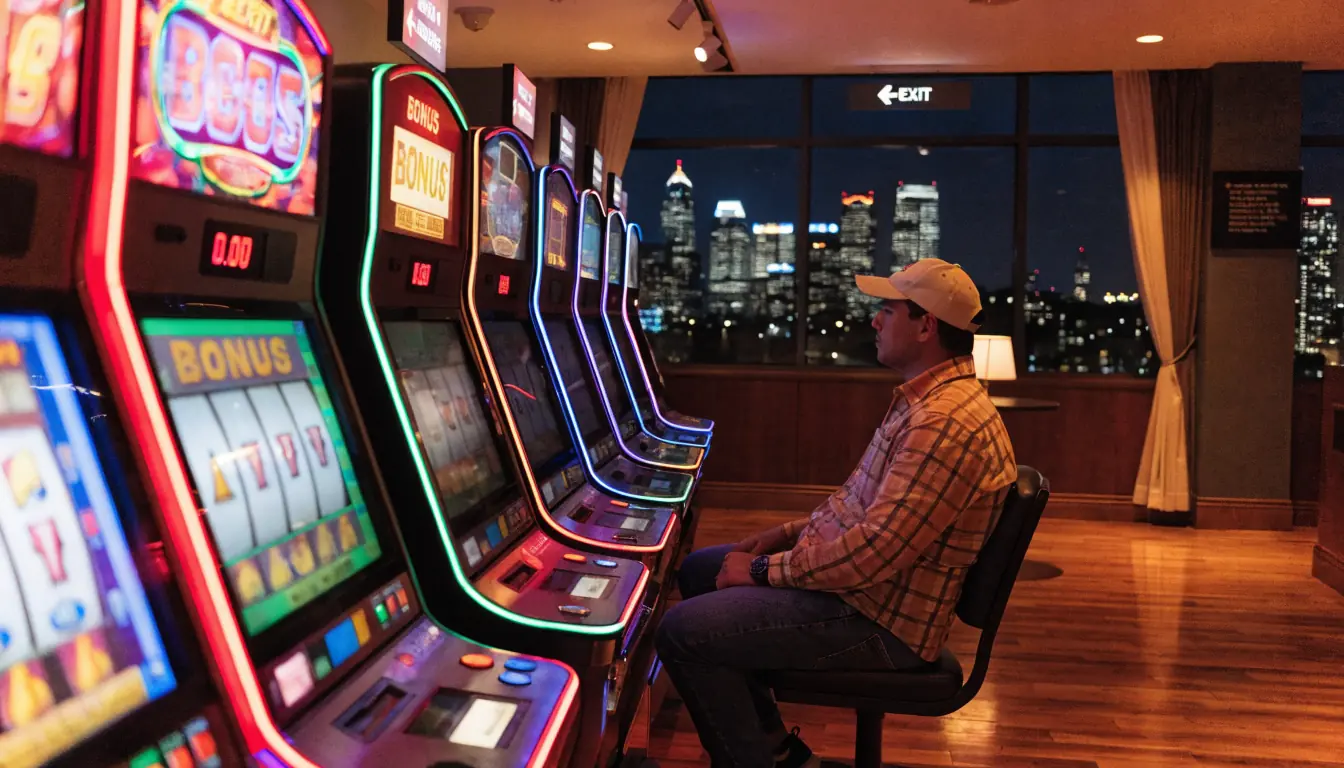
Walk into any pub or club in Australia and the pokies are there — rows of them, lit up, waiting. That’s the machine culture this country grew up on. But on an Android phone the picture looks different, and the difference is worth understanding before anyone taps "install" on anything.
The short version: what you can legitimately download for free on Android in Australia is a free-play product. It looks like a pokie, spins like a pokie, sounds like a pokie — and pays nothing. The real-money version of that experience cannot be lawfully offered to Australian residents online under the Interactive Gambling Act 2001. The law targets operators, not players, but from a downloader’s point of view the practical outcome is the same: the app store landscape for "pokies" in this country is dominated by apps where the money is fake, or where the money isn’t money at all.
I’ve spent enough time around this industry to know that the word "free" in app marketing does a lot of quiet work. Sometimes it means free. Sometimes it means free until a pop-up appears. Knowing which one you’ve downloaded is most of the battle.
What "free" actually means in these apps
There are roughly three kinds of free pokies experiences available on Android, and they operate on very different economics.
Social casino apps. These are the big ones — the apps with millions of downloads that give you a pile of virtual coins on sign-up and let you spin. The reels, the themes, the bonus rounds are modelled on real machines, sometimes directly licensed from the same studios that build the cabinets you’d find in a club. What’s absent is withdrawal. You cannot cash out. The coins have no redemption value, and the app will tell you so in the fine print nobody reads — usually in a clause that says the virtual currency has no real-world value and cannot be exchanged for money.
That’s the honest version. The business model isn’t the spinning; it’s selling more coins when you run out. In-app purchases of virtual currency are where these apps make their money, and the people who spend heavily on them are the engine of the whole category. A "free" app with a steady stream of coin purchases is not free in any meaningful sense for that player — it just carries no possibility of return.
Demo or practice versions of real games. Some game studios publish free-play builds of their actual titles — the same mathematics, the same volatility, the same hit frequency, but running on play credits. These sit closer to the real product than social casinos do, because the game itself is identical. What differs is the account layer: nothing is deposited, nothing is withdrawn, nothing is tracked as money.
Free apps that funnel toward offshore real-money sites. These exist, and I’d treat them with more caution than either of the above. The app itself is a free-play shell; the monetisation happens when it points you toward a website where real-money play is on offer. Under Australian law it’s the operator, not the player, who commits the offence by offering that — but an app whose real business is routing Australians to offshore casinos is not operating in your interest, whatever the store listing says. I’ve seen enough of these to recognise the pattern: thin game, heavy prompts, a "play for real" button that appears once you’re a few sessions in.
How free pokies differ from the real thing — and where they don’t
The mechanics can be identical. Same reel sets, same symbol paytables, same bonus triggers. A demo build of a given title is the same game with the money stripped out.
But strip the money out and several things change that aren’t immediately obvious:
There is no loss. Obvious, but it changes behaviour. On a real machine, a losing session costs you. On a free app, a losing session costs nothing, which means the game’s design — the near-misses, the anticipation, the sounds that celebrate a "win" smaller than the bet that produced it — is operating on you with the brake removed. Anyone who thinks free pokies are harmless practice for the real thing should notice that they’re practising the habit loop, not the risk.
Progress doesn’t transfer. Coins won in a free app cannot be converted into credit anywhere. The app store listings that imply otherwise — and some are written to walk right up to that line — are trading on ambiguity. If an app promises winnings you can "claim," read where. In every legitimate free-play product I’ve looked at, the answer is nowhere.
Regulatory visibility differs. Real machines in pubs, clubs and casinos sit inside a compliance framework: cash transaction reporting, suspicious matter reporting, identification requirements depending on venue size. A free app on your phone sits outside all of that, because there’s no money to monitor. That’s worth holding onto as the industry conversation shifts — according to facctum.com, cashless account-based pokies are being pushed because they improve traceability of deposits, gameplay and withdrawals, and regulators recommend tighter customer due diligence and transaction monitoring alongside cashless adoption. Free apps have no deposits to trace. That’s simultaneously their selling point and the reason they’re a regulatory blind spot.
Why free pokies stay popular anyway
If there’s no money, why do millions of Australians download them? A few reasons, and none of them are mysterious.

Nostalgia and familiarity. The pokie is a fixture of Australian venue culture — they’re in the pubs, the clubs, the casinos. A free app is a way to interact with a familiar machine without driving to one. Players who grew up on particular cabinets want the same titles, the same themes, the same feel. Aristocrat’s name carries particular weight here; the company’s cabinet games are woven into Australian venue culture, and free-play versions of familiar titles trade directly on that recognition. I’ll leave the specifics of Aristocrat’s signature styling to the section that covers it properly.
Entertainment as a budget line. Some players have made a deliberate choice: they enjoy the format but have decided the money is better spent elsewhere. A coin purchase in a social app is, for them, the same category of spend as any other mobile game — a known price for a known amount of entertainment, with a guaranteed zero on the withdrawal side. That’s a rational position. What it requires is the player actually understanding the transaction, which brings me to the next point.
Practice and curiosity. New players use free versions to learn how features work — what a scatter does, how a hold-and-respin mechanic plays out. That’s a legitimate use, though it teaches the mechanics, not the discipline.
What to check before downloading
I apply a short list to any free pokies app, and I’d suggest the same habit:
- Where does the money go? If the app sells coins, it should say so plainly and state that coins have no cash value. An app that buries that statement or fudges it is telling you its business model up front.
- Is there a “real money” path? Any prompt toward an external gambling site is a flag, particularly one aimed at Australian users. Domestic real-money online pokies cannot be licensed here, so anything promising that is routing offshore by definition.
- What permissions does it ask for? A spinning-reels game has no need for a broad grant of device access. Excessive permission requests are a problem on their own, independent of gambling.
- Age gating. The minimum legal gambling age in Australia is 18, and the problem isn’t theoretical — almost one in three Australians aged 12 to 17 gamble. Free pokies apps with weak age checks are, functionally, gambling-format entertainment delivered to minors, and the industry’s own record on this is not reassuring.
The honest framing
Free Android pokies are best understood as entertainment software built on the chassis of a gambling product. The chassis is real — the mathematics, the pacing, the psychology of the spin cycle are the same engineering that goes into machines handling real money in venues. What’s removed is the stake, and with it both the risk and the return.
For a player who wants that, with clear eyes about what the app is selling and where its revenue comes from, it’s a coherent choice. For a player who thinks of a free app as a stepping stone to real-money play — or worse, as evidence that the real-money version works the same way in their favour — it’s worth being precise about what the app can and cannot show. It can show you a game. It cannot show you what losing money feels like, and that, in the end, is the only lesson the real machines teach.
The app store won’t explain any of this. That’s the job of whoever’s writing the description — and now you’ve read one that does.
Downloading Free Pokies – No‑Install and Instant‑Play Options
For years, the default way to play pokies on an Android phone was to install something — an APK file sideloaded from a site of questionable origin, because app stores were never enthusiastic about gambling software. I remember testing those files myself: half of them asked for permissions no slot game needs, and the other half were clones of the same three Aristocrat titles with the names filed off. That era didn’t end because anyone cracked down on it specifically. It ended because the browser got good enough to make installing anything unnecessary.
How instant play actually works
Modern free pokies run on HTML5. The game loads in the Chrome or Firefox browser on an Android device, plays in the page, and disappears when the tab closes. No APK, no sideloading, no storage eaten by an app that duplicates what a website already does. For free-play versions — the ones with no money on the line — this is now the standard delivery method, and honestly the only sensible one.
The technical reasons are straightforward:
- Android restricts installation of apps from outside official channels, and overriding that restriction takes several deliberate steps most users won’t take.
- A browser game updates itself; an installed file doesn’t, and outdated builds are where the problems live.
- Nothing installed means nothing to uninstall when the game stops working or the operator disappears.
The regulatory reason nobody advertises
There’s a second layer, and it’s the one that matters on this market. Under the Interactive Gambling Act 2001, offering real-money online casino games to Australian residents is an offence, and there is no domestic licence an operator could hold to make it legal. A downloadable app is a permanent, identifiable artefact — a package that can be pointed at, blocked, or cited. A browser page is easier to take down and, for operators working from offshore, easier to relocate when the Australian Communications and Media Authority (ACMA) takes an interest.
So the shift toward "no download" play isn’t purely a convenience story. It’s partly a compliance surface: free-play versions with no wagering carry no cash and no player accounts, which keeps them on the safe side of the line, and the instant-play format suits that model. Nothing to deposit, nothing to withdraw, nothing to launder. It’s worth noting that the anti‑money‑laundering machinery around pokies — AUSTRAC’s red-flag guidance, the reporting obligations on venue operators — is built for machines handling physical cash. A free browser game touches none of it, by design.
What this means in practice
When a site advertising "free Aristocrat pokies for Android, no download" puts the games in the page itself rather than handing over an installer, that’s the format working as intended. What it isn’t, in Australia, is a doorway into licensed real-money play — no such doorway exists domestically, whatever the surrounding banners imply. The "free" and the "no download" go together for reasons that have as much to do with the law as with convenience.
That’s the whole mechanic. Play, close tab, done.
Aristocrat’s "Dreaming Indian" Theme – Understanding the Brand’s Signature Style
Aristocrat built its name on recognisable cabinets before it ever thought about phones, and "Indian Dreaming" is one of the themes people still ask for by name. The request usually arrives typed in a hurry — aristocrat pokies indian dreaming android — and the honest answer splits in two: the theme is real, the Android download with real-money play is not, because the Interactive Gambling Act 2001 bars operators from offering online casino games to Australian residents, and no domestic licence exists to change that.
What people remember about the theme is its density. Tied totems, feathered headdresses, a warm ochre-and-teal palette, and a soundscape that signals wins before the reels stop. These are deliberate choices: cabinet pokies compete for attention in a venue full of noise, so the art does the marketing. Aristocrat’s Indian-themed titles carried that visual weight across generations of machines, which is why the name still draws searches long after the cabinets left some floors.
On Android, that style survives only in free-play versions — demo apps and social casinos with no monetary stakes. They reproduce the symbols and sound design but not the wagering, and that gap is not a technical limitation. It is the regulatory line drawn between venue-based machines, which are legal and heavily monitored, and online casino play, which Australian residents can access only through offshore operators at their own discretion — the law targets the operators, not the players.
The theme’s persistence says something about the broader ecosystem. Pokies are woven into pubs, clubs and casinos across every state and territory, and a signature style that players can recognise across decades is a commercial asset in that environment. According to facctum.com, the industry’s direction of travel is toward cashless, account-based machines, with transparent systems providing full traceability of deposits, gameplay and withdrawals. A recognisable theme sells the machine; the account behind it is what regulators increasingly care about.
Nostalgia travels to Android. Money does not.
Written by the editors at Casino Mobile Guide.