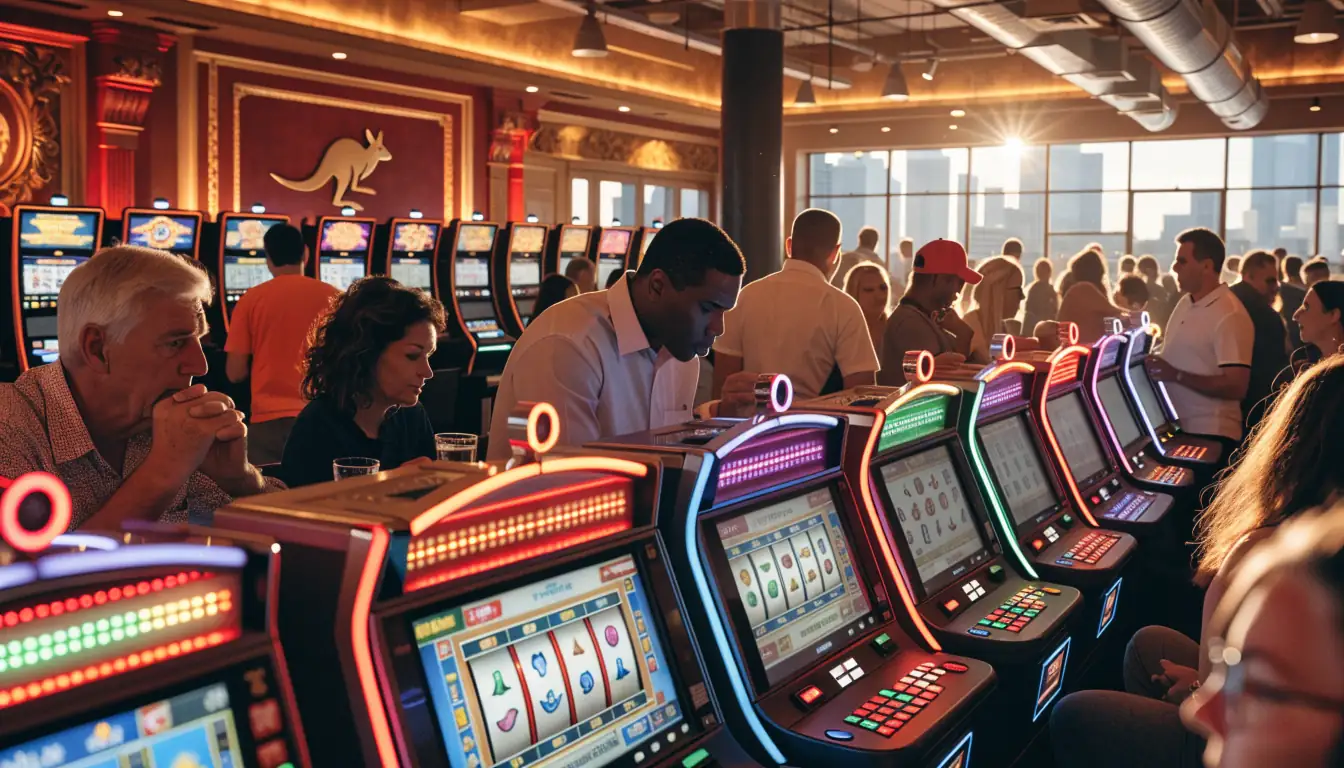
Best Bonus Buy Slots in Australia: How They Work
 Available in AU
Bonus Buy Slots in Australia: What They Are and How They Differ
A bonus buy slot is a game where the base game — the ordinary spinning of reels — can be skipped, and the feature round purchased outright. Instead of waiting for scatter symbols to land, a player pays a set price and the free spins, hold-and-win round, or multiplier feature starts immediately. That is the whole mechanic in one sentence. Everything else — pricing, availability, the arguments for and against, the way the feature sits inside Australian gambling law — grows out of that single idea.
The word "bonus" in the name causes more confusion than any other part of it. It has nothing to do with a casino’s promotional offers. There is no marketing department involved, no wagering requirement attached, no promotion running behind it. The "bonus" being bought is the game’s own internal feature round — the thing the slot was designed around. Buying it is a wager, not a redemption. The money leaves the balance the same way a spin bet does, and the outcome is governed by the same random number generator. In practice, the phrase "bonus buy casino" that players type into search boxes usually means a casino whose game library includes titles with this purchase option. That is a library question, not a bonus question, and the difference matters enough that I’ll come back to it.
If you’re chasing bonus buy slots in Australia in 2026, the welcome offer and how quickly you can access your winnings often matter as much as the game library itself, so it pays to check what each casino actually puts on the table before signing up.
License: Curacao Gaming Control Board OGL/2023/174/0082 (Dama N.V.) · Bonus: up to A$5,000 + 300 free spins across 4 deposits Operates under a Curacao Gaming Control Board licence via Dama N.V. and backs its welcome package with a sizeable bonus spread across four deposits plus a generous batch of free spins.
License: Curacao – Antillephone N.V. (Versus Odds B.V.) · Bonus: up to EUR 2,000 across 5 deposits + 200 free spins · Min. deposit: EUR 20 Licensed in Curacao through Versus Odds B.V., this operator spreads its welcome bonus across five deposits with a solid free spins allowance, and a modest minimum deposit keeps entry accessible.
License: Curacao eGaming (Dama N.V.) · Bonus: up to A$10,000 + 180 free spins, 40x wagering Holds a Curacao eGaming licence under Dama N.V. and offers a large headline bonus with free spins, though the 40x wagering requirement is worth factoring in before claiming.
Bonus: up to A$7,500 + 550 free spins across 10 deposits, 50x wagering · Payout speed: crypto under 1 hour, PayID 1-3 business days · Min. deposit: A$20 (A$30 to qualify for the bonus) Stands out for its extensive 10-deposit bonus structure with a big free spins haul, and for payout speed, with crypto withdrawals processed in under an hour and PayID within a few business days.
License: Curacao Gaming Authority (Jumpman Gaming Ltd) · Bonus: up to A$6,600 + up to 250 free spins across 4 deposits Licensed under the Curacao Gaming Authority via Jumpman Gaming Ltd, it offers a substantial welcome bonus with free spins spread over four deposits.
License: Curacao eGaming (Roby Games Ltd) · Bonus: 100% up to A$750 + 200 free spins Operating under a Curacao eGaming licence through Roby Games Ltd, it keeps things straightforward with a percentage-matched bonus and a solid free spins allocation.
Bonus: 240% up to A$4,100 + 300 free spins Notable for a high-percentage welcome bonus combined with a generous free spins package, making its headline offer one of the more eye-catching on paper.
License: international iGaming licence – jurisdiction not named in the source · Bonus: 100% up to A$1,000 + 100 free spins, 35x wagering · Payout speed: PayID 1-24 hours · Min. deposit: A$30 (PayID from A$10) Runs under an international iGaming licence and combines a welcome bonus with free spins and reasonable wagering terms, while PayID withdrawals can land within a day and a low minimum deposit lowers the entry bar.
License: Curacao eGaming (Hollycorn N.V., since 2017) · Bonus: 225% up to A$1,540 + 600 free spins across 4 deposits, 20x wagering · Min. deposit: A$20-30 (depends on the offer) Licensed by Curacao eGaming through the long-established Hollycorn N.V. (since 2017), it offers a high-percentage bonus spread across four deposits with a large free spins count and comparatively low 20x wagering.
License: Curacao Gaming Control Board · Bonus: up to A$5,000 + 400 free spins Holds a Curacao Gaming Control Board licence and pairs a substantial bonus amount with a healthy number of free spins.
What the purchase actually is
When a slot offers a bonus purchase, a button appears in the interface — often labelled "Buy Feature," "Buy Bonus," or with the provider’s own branding on the mechanic. Pressing it does not trigger anything on its own. First the game shows the price, which is expressed as a multiple of the base bet. The player confirms, the amount is deducted, and the feature round begins.
What happens next is not a guaranteed win, and this is where the marketing language and the mathematics part company. The feature round runs on the same random number generator as the base game. Each outcome is drawn independently, exactly as it would be if the player had reached the feature through ordinary play. What the purchase buys is entry, not result. A bought round can pay nothing. A bought round can pay many times the purchase price. Over a long enough run of purchases, the results trend toward the game’s built-in return figures — but no single purchase carries any entitlement beyond participation.
I’ve watched players talk about bought features as though the price creates an obligation on the game’s side. It doesn’t. The price is calibrated so that, in aggregate, purchases return roughly what the game is built to return. The house-edge percentage doesn’t disappear because the wager took a different route into the machine. RTP and house-edge percentage are inverse values — a game returning 96% over time has a 4% house-edge percentage built in, and a purchased feature sits inside that same structure. The purchase is a bet at a different price point, nothing more.
Why the mechanic exists at all
Feature rounds are the emotional centre of modern slot design. The base game exists to build anticipation; the feature is where the big multiplier chains and the memorable wins live. For a sizeable share of players, waiting through hundreds of base-game spins to reach that centre is the friction, not the fun.
The purchase option removes the friction. It answers a demand that players themselves expressed, loudly, for years — in forums, in chat streams, in the way people talked about "grinding" to a bonus. When providers like Relax Gaming and Pragmatic Play built formal purchase mechanics, they were formalising behaviour that already existed. Before the buttons appeared, some players treated high-volatility games as bonus-or-nothing propositions, spinning the base game reluctantly and quitting the moment a feature landed. The buy option just made that pattern explicit and priced it.
There is an honest way to describe this and a dishonest one. The honest description: the mechanic lets a player exchange a large number of small, uncertain wagers for one large, uncertain wager with a defined starting point. The dishonest description — the one the advertising copy leans on — is that the feature is where the "real" money is and buying it gets you there faster. The mathematics does not support "faster" as an advantage. It supports "different" as a description. Whether different is better depends entirely on the player’s bankroll, patience, and tolerance for the base game itself.
RTP of 97%, medium volatility.
RTP of 98.06%, medium volatility.
RTP of 97%, very high volatility.
The RTP structure underneath
To understand what a purchase actually buys, it helps to understand the return-to-player figure that governs every wager on the machine — purchases included.
Return to player (RTP) is the percentage of wagered money a slot machine returns to players over time. The calculation uses probability-weighted outcomes: every possible result of every possible spin, weighted by how likely it is, summed into a single expected figure. A 96% RTP slot is built to return about $96 for every $100 wagered — not to any individual player in any individual session, but across the full population of wagers over the game’s life. Regulators and testing houses arrive at these numbers by running computer simulations of millions or billions of spins. No human session is long enough to resemble that distribution.
RTP can also be measured empirically. If a slot takes $110,000 in total bets and pays back $100,000 in winnings, its RTP over that period is 90.9%. That is the same arithmetic a venue or an operator’s reporting system performs on real machines in real time. The theoretical figure and the measured figure converge only over enormous volume; in any window a player actually experiences, the gap between them is where luck lives.
The industry benchmark for RTP sits around 96%. Games above that line get marketed as high RTP; games below it as low RTP. Volatility is the separate axis that describes win patterns — the frequency and size of payouts. A high-volatility game pays rarely and sometimes enormously; a low-volatility game pays often and modestly. RTP says how much comes back in total. Volatility says how it is distributed. Two games with identical RTP can feel like entirely different products depending on where they sit on the volatility scale, and bonus buy titles cluster heavily at the high end — because the feature rounds being purchased are the volatile part.
How purchases interact with RTP
Here is the part that the interface never spells out. The purchase price of a feature is set so that the purchased round, considered as its own wager, carries the game’s expected return. The provider prices the buy using the same probability-weighted arithmetic that produces the RTP figure in the first place. The round costs what it costs because that price makes the purchase, in expectation, equivalent to the wagers a player would have made reaching the feature organically.
This has a practical consequence worth stating plainly: a player who buys features repeatedly is running a high-stakes, high-volatility betting strategy on a game whose long-run return has not changed. The percentage coming back is the same. What has changed is the shape of the ride — fewer wagers, larger wagers, outcomes arriving in bigger, rarer chunks. For a player with a limited bankroll, that shape can be punishing, because volatility plus a small bankroll plus a fixed return percentage equals a high probability of finishing the session down. The RTP is not violated when that happens. It was never a promise about one player’s evening.
High volatility risk
Playing high‑volatility bonus‑buy slots can quickly drain a limited bankroll, even though the RTP remains unchanged.
The Federal Court of Australia has warned, in the context of RTP claims, that a high RTP does not guarantee winnings in short sessions — and a purchased feature is the shortest session there is: one wager, one round, one result. Any framing of bonus buys that implies the purchase improves the player’s expected return is not just marketing; it is wrong on the arithmetic.
What the market calls these games
The vocabulary around this mechanic is a tangle of search-shorthand and provider branding, and untangling it helps when comparing games or reading reviews.
- Bonus buy slots / buy bonus slots — the general terms for any slot with a purchasable feature round. Used interchangeably by players, reviewers, and aggregators.
- Feature buy / Buy Feature — the interface label most providers put on the button itself. Relax Gaming’s “Dream Drop” era games and Pragmatic Play titles popularised the phrasing.
- Ante bet — a related but distinct mechanic where a player pays an increased stake per spin to raise the probability of triggering the feature naturally. An ante bet modifies the base game; a bonus buy replaces it. Some games offer both, and the distinction is worth checking before assuming a game has a purchase option at all.
- Bonus buy casino — player shorthand for an online casino whose library includes bonus buy titles. It describes a catalogue, not a promotional structure.
One further term belongs in this list because it changes what any of these games return: configurable RTP. Providers build games with multiple approved RTP settings, and the same slot can run at different return figures at different operators. The RTP a game shows in its information screen is the RTP of that specific deployment — not a property of the title in general. When comparing bonus buy games across venues, the purchase price and the RTP setting should be checked together, since both are deployment choices, not fixed features of the game.
Concrete examples, with the caveats they deserve
Specific titles make this concrete, and the provider BGaming publishes RTP and volatility figures for its games on its own site. These are single-source figures from the provider’s own materials, not industry-verified norms, so they should be read as what the provider states rather than as settled market data:
- Golden Paw: Hold & Win — stated RTP of 97%, medium volatility.
- Cat’s Soup — stated RTP of 98.06%, medium volatility.
- Aztec Clusters — stated RTP of 97%, very high volatility.
- Merge Up™ 2 — stated RTP of 97%, very high volatility.
- Always Up! x10000 — stated RTP of 96.05%, very high volatility.
- Blazing Fire Pots Hold & Spin — stated RTP of 96.27%, medium-high volatility.
The pattern in that list is the pattern in the category. The medium-volatility entries sit at or above the benchmark figure; the very-high-volatility entries span from just above benchmark to comfortably above it. Volatility and RTP are independent axes, but bonus buy design pulls games toward high volatility because the purchasable round is where the game’s variance is concentrated. A provider building a feature worth buying has to build a feature capable of out-paying its own price sometimes — which means building one capable of paying nothing most of the time.
And the standing caveat applies to every figure above: per the bgaming.com listings these are the stated figures for these deployments. The same games, hosted elsewhere, could carry different configurable RTP settings, and the only authoritative source for what a specific game at a specific venue returns is that game’s own information screen at that venue.
Online versus land-based in Australia
The bonus buy mechanic arrived through online slots, and in Australia the online and land-based environments are radically different worlds.
Online bonus‑buy slots accessed from Australia are hosted by offshore‑licensed operators, as domestic licences for real‑money casino games do not exist.
In the land-based environment, the slot machines Australians play — the pokies in clubs, hotels, and casinos — do not carry feature-purchase mechanics. The regulatory settings that govern Australian venues, the game approval processes, and the machine configurations in domestic casinos are built around continuous play with regulated return floors. Crown Perth, for instance, operates with a stated minimum RTP of 90% across its slot machines — a floor that reflects the venue-based regulatory approach of setting a return band rather than a single benchmark figure. Game information in Australia often includes RTP values as a player-protection measure; the figure is treated as disclosure, not as a selling point.
Online slots, meanwhile, have higher RTP than land-based slots. This is a structural fact of the two formats, and it shapes what a bonus buy means in each context. A purchased feature on an online game priced around the benchmark figure is a different proposition from anything available on an Australian club floor — not because the purchase is cleverer, but because the entire return structure of the online game sits higher.
There is also the matter of where those online games are offered from. There are no domestically licensed real-money online casino operators available to Australian players; the domestic licensing framework covers wagering and lotteries, not casino games. The online slots that carry bonus buy features and are accessible from Australia are hosted by offshore-licensed operators. That is a legal landscape question with its own detail, and the next section of this article deals with it directly — the point here is narrower: the bonus buy category, as Australian players encounter it, is an offshore-hosted category by default, because that is where the games live.
Why bonus buys are not casino bonuses
The confusion between a purchasable feature and a promotional offer is worth dismantling piece by piece, because players lose real money to the misunderstanding.
A casino bonus — a deposit match, free spins package, cashback arrangement — is a promotional instrument. It is offered by the operator, not the game. It comes attached to conditions: the display of wagering requirements up front is an obligation operators carry before offering any bonus. The bonus exists to acquire or retain a customer. Its economics are the operator’s marketing economics.
bonus buy
A feature that allows a player to pay a set price to jump straight into a slot’s bonus round, bypassing the base‑game spins.
A bonus buy is a wager. It is offered by the game, not the operator. It carries no conditions, because it is not a promotion — there is nothing to unlock or turn over. Its economics are the game’s built-in return economics. The operator earns its house-edge percentage share either way; whether a player triggers a feature organically or buys it, the wager passes through the same structure.
Mixing the two up produces bad decisions in both directions. A player who treats a purchase as "free" value because the word bonus appears on the button is misreading the product entirely. A player who expects a promotional offer’s conditions to apply to a purchased feature is looking for rules that do not exist. And a player evaluating a "bonus buy casino" purely on whether the purchase buttons exist is evaluating one variable while the more consequential ones — the RTP settings the operator has chosen for its games, the volatility profile of the library, the integrity of the operator itself — go unexamined.
What a purchase changes and what it doesn’t
Running through the mechanics once more, cleanly, because the summary is the point of this whole section.
A purchase changes:
- The number of wagers. One large wager replaces a run of small ones.
- The waiting. The feature round begins immediately; no anticipation is built through base play.
- The session shape. Outcomes arrive in concentrated, high-variance parcels rather than a continuous stream.
- The bankroll exposure per decision. Each purchase is a single decision carrying the full price, which concentrates risk at moments of choice.
A purchase does not change:
- The RTP. The purchased round is priced within the game’s return structure. The expected return of the wager is the game’s expected return.
- The randomness. Every outcome is drawn by the same RNG, independently, with no influence from previous spins — including previous purchases.
- The house-edge percentage. RTP and house-edge percentage are inverse values, and neither moves because the wager’s entry point changed.
- The volatility of the game. Buying the feature concentrates exposure to the game’s existing variance; it does not create variance the game lacks.
A note on that third point, because it’s the one players test hardest: the RNG does not track purchases. A bought round that pays nothing does not make the next purchase more likely to pay. A bought round that pays enormously does not make the next one less likely. Each spin — and a bought feature is a sequence of spins — is independent. There is no debt, no cycle, no compensation. Anyone describing bonus buys in terms of a feature being "due" or a game "owing" after bad purchases is describing a machine that does not exist.
The volatility question, honestly framed
Because bonus buy titles skew volatile, the honest question is not "is buying features good or bad" but "what does concentrated volatility do to a bankroll."
A very high volatility game distributes its return in rare, large parcels. That distribution exists whether the player reaches it through base spins or purchases. What the purchase does is let the player choose the parcel size. And what concentrated parcel size does to a finite bankroll is arithmetic: a player who makes a small number of very large wagers against a fixed return percentage faces a high probability of ending the session below the starting point, and a small probability of ending well above it. The theoretical RTP holds across the full population of wagers. The experienced RTP — what any one player actually sees in a limited session — can sit anywhere, and the more volatile the game, the wider the spread.
Core Insight
A bonus‑buy purchase reshapes the wagering experience but does not alter the underlying RTP or house edge.
None of this makes the mechanic a scam. The pricing is consistent with the mathematics, the outcomes are certified random — regulatory certification requires third-party RTP verification, and testing houses like BMM Testlabs, GLI, iTech Labs, and eCOGRA exist to perform exactly that verification on the games and their feature rounds. The mechanic is what it says it is: a direct purchase of a random outcome in a defined feature round. The problems arise when the framing around it — "instant access to the big wins," "skip the wait" — encourages players to treat the purchase as a shortcut to expected profit rather than as a wager of a particular shape.
Reading the "best bonus buy slots" question properly
When players search for the best bonus buy slots for Australia, they are usually looking for a list — and the honest answer is that "best" decomposes into a handful of checkable properties rather than a ranking.
The first property is the RTP setting of the specific deployment. With configurable RTP, the same title can return different amounts at different operators, so the figure on the game’s information page outranks any figure in a review. The second is volatility, which should be matched to bankroll and patience rather than maximised by default. The third is the purchase price relative to the base bet, which determines how concentrated each wager becomes. The fourth is the feature’s design itself — hold-and-win, free spins with escalating multipliers, cluster mechanics — because a purchased round is only worth its price if the round is one the player actually wants to sit through repeatedly.
And the fifth, which no list format captures, is the operator. The games are products; the venue deploying them is a separate decision with separate stakes. In the Australian context, where the online casino space sits outside the domestic licensing framework entirely, that separation is not a footnote. It is the difference between a good game and a good experience.
The disclosure gap
There is one more thing that belongs in an honest account of this category, and it is an absence rather than a fact. The specific conditions that attach to bonus buy play — where operators publish them at all — are not published in any standardised, comparable form. There is no official source that consolidates purchase pricing across providers, no public register of which RTP settings are deployed where, and no obligation on offshore operators to disclose their deployment choices to Australian players in any particular way. A player who wants to know what a specific game returns at a specific venue has to open that game and read its information screen. That is the whole of the available verification, and it is worth knowing that this is the ceiling of what can be known before playing, not a failure of research.
Disclosure gap
Operators are not required to publish the exact RTP or purchase pricing they use for each game, so players must verify these details in‑game.
The disclosure that does exist is worth using. Games certified for regulated markets carry their RTP in the information screen, providers publish their own figures on their own sites, and testing-house certification is traceable. A player who checks the in-game RTP against the provider’s stated figure, and finds them consistent, has done the verification that the market actually supports. A player who skips the check is trusting a deployment choice nobody is obliged to disclose.
Where this leaves the category
Bonus buy slots are neither the innovation the promotions imply nor the menace the critics describe. They are a pricing option on an existing structure — a way to convert a long sequence of wagers into a short one without changing the return mathematics underneath. In Australia the category arrives entirely through offshore-hosted online games, against a domestic machine environment built on different principles and different return floors, and the gap between those two worlds is the gap the rest of this article maps.
What a player does with the mechanic is a bankroll decision before it is a game decision. The purchase button does not change the odds, the RTP, or the house-edge percentage. It changes the shape of the ride.
That’s the whole trick.
Casino Bonus Buy and Demo Options: Legal Landscape in Australia
When people search for a "casino bonus buy," they are often mixing two different things: the in-game feature that lets a player pay to jump straight into a slot’s bonus round, and the promotional bonuses an online casino hands out — match deposits, free spins, and the rest. The first is a mechanic built into the game itself. The second is a marketing product built by the operator. In Australia, the legal story around both is more complicated than most comparison sites admit, and some of what is written about it is flatly wrong.
What the law actually prohibits
The primary Commonwealth law is the Interactive Gambling Act 2001 (IGA), introduced with a public-protection and harm-minimisation focus. Under the IGA, online casino-style games — slots, poker, blackjack, roulette — cannot be offered to Australian residents. Online poker and live in-play betting are prohibited federally as well. There is no Australian licence an operator can hold to run an online casino; it is not a matter of meeting requirements, it is a matter of the licence not existing. Online sports betting, by contrast, is legal under state and territory licences.
One point of confusion worth naming plainly: some sources cite an "Interactive Gambling Act 1997" as the law prohibiting online casino games for Australian residents. Sources disagree on the year. The 2001 Act is the one consistently identified as the primary Commonwealth law governing online gambling, so treat any reference to a 1997 Act with caution.
The other thing the IGA does not do is criminalise the player. It is not illegal for an individual Australian to play at an offshore-licensed online casino. The law targets the operators, not the people at the keyboard. That asymmetry is why offshore sites remain visible in Australia and why nobody has ever been prosecuted simply for spinning a slot at one.
Why this makes "licensed operator" advice hollow
Most international guides tell players to check an operator’s licence before buying a bonus. On this market, that advice lands strangely. There are no domestically licensed real-money online casino operators available to Australian players, and no public registry of licence holders exists for online casino play — because the licence itself does not exist. An offshore site may hold a licence from an authority such as the Malta Gaming Authority or the UK Gambling Commission, but that licence does not authorise service to Australians, and an Australian regulator does not stand behind it.
So when a casino site advertises its "bonus buy" options to an Australian audience, the licence it displays in the footer — however real — is not a domestic guarantee. It is a foreign document with no reach here. That is the part marketing copy tends to leave unsaid.
Bonus mechanics versus bonus offers
The distinction matters for anyone comparing games. A bonus-buy feature is priced inside the game by the developer and behaves the same way wherever the game runs: the purchase cost, the mechanics of the round you jump into, and the RNG driving outcomes are built into the title itself. A casino bonus, on the other hand, is an operator’s promotion layered on top of the game — and the conditions attached to it (wagering, caps, timeframes) are set by each casino, which is exactly why promotional offers vary so wildly between sites running identical games.
Where demo modes fit
Demo versions — free-play builds of the same slots, sometimes with the bonus-buy option available in play-money form — sit in a greyer position than real-money play. Since no real wager changes hands, a demo is not gambling in the ordinary sense. But the demo is also where the distinction between game feature and casino promotion blurs most easily: a "slot demo bonus buy" in free play shows the purchase mechanic without any of the promotional conditions that attach once money is involved, which can give a misleading picture of what the feature costs in a real session. Worth remembering before treating demo behaviour as a preview of the real thing.
The honest summary
Buying a bonus on a slot machine is a game feature, legal in itself, offered through channels the IGA prohibits to operators and tolerates in players. Anyone claiming to point Australians to a "licensed" online casino for bonus buying is describing a licence this market does not issue. The framework protects by restriction, not by regulation of play. That is the landscape — unusual, and rarely stated this directly.
How to Purchase a Bonus on Australian Slot Machines
Buying a bonus on a slot machine is a short procedure, and it works the same way wherever the feature is offered.
- Open a game that supports bonus buying. Not every title has the option — the game screen states plainly whether the feature exists.
- Locate the buy button. It sits next to the spin controls, labelled with the cost of entry. That price is stated up front, before anything is committed.
- Confirm the purchase. The machine deducts the cost and drops the player straight into the feature round.
- Play the feature. From here, the round runs like any other.
One mechanic matters more than the steps. The Random Number Generator (RNG) governs the purchased feature exactly as it governs an ordinary spin: each outcome is independent, random, and untouched by anything that came before. Buying entry skips the waiting, not the odds.
There is also a gap worth naming. Theoretical RTP is the percentage built into the game; experienced RTP is what a player actually sees over a limited session. A single bought feature can land far from either figure. Buying does not change the mathematics — it concentrates spend into one round.
Created by the ”Casino Mobile Guide” editorial team.